Weekly Solar Insights: VAT Comes Off UK Electricity Bills, Germany's EEG Reform Reaches Parliament, and Italy's Export Payments Get Real (Week of 7 September 2026)
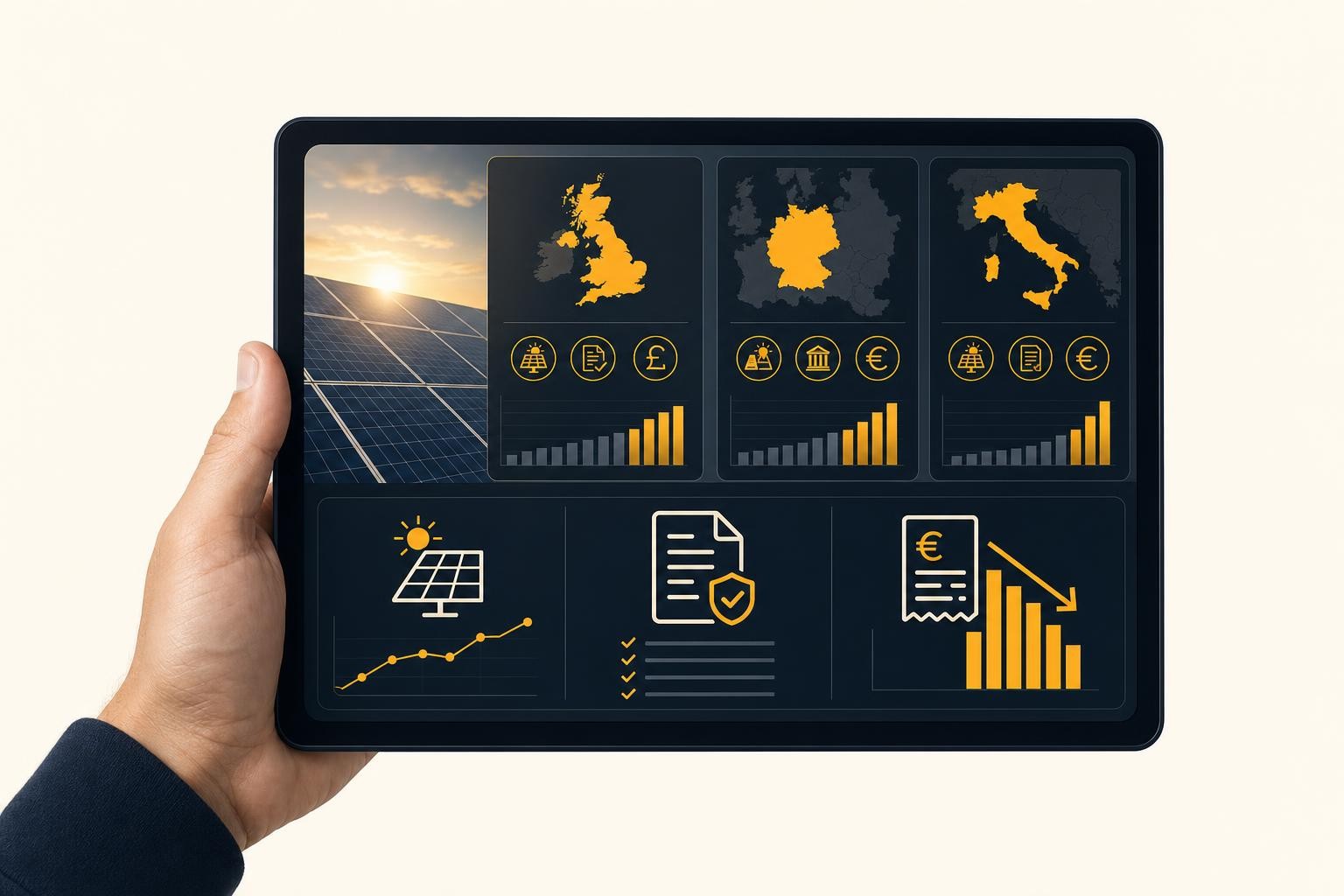
Hello again, and welcome to your weekly catch-up on home energy in Germany, the UK and Italy. This week is a genuinely interesting one: British households are about to see a tax disappear from their electricity bills, Germany's big solar law finally reaches parliament, and Italy's switch away from its old export scheme is starting to bite. Here's what changed, in plain English, and what it actually means for your roof.
UK: bills go up 4%, but VAT comes off electricity
Two things are happening at once, and they pull in opposite directions.
First, Ofgem confirmed on 26 August that the energy price cap rises by 4% for October to December. A typical household paying by direct debit for gas and electricity goes from £1,663 to £1,723 a year[1]. That sounds like bad news, and for anyone heating with gas it is: gas bills are rising about 8%.
But here's the more interesting half. From 1 October, VAT is being removed from household electricity bills in England, Scotland and Wales, saving the average home around £45 a year[2]. Because that discount lands on the electricity side, Ofgem's own figures show electricity costs staying broadly stable, and a home that uses no gas at all sees an increase of less than 1%[1].
Two caveats worth knowing. The VAT cut is currently set to run until 31 March 2027, after which the 5% rate is expected to return. And Northern Ireland is not included, because of the post-Brexit VAT arrangements.
What this means for you: if you have solar, or a heat pump, or you are simply an all-electric household, this quarter tilts in your favour. Rising gas costs and cheaper electricity is exactly the direction that makes electrifying your home look smarter over time. It's also a good moment to check your export tariff: Smart Export Guarantee rates still vary enormously, from a few pence per kWh on basic deals to around 15-16.5p on the best open flat rates, and up to roughly 30p during peak evening hours on smart tariffs designed for homes with a battery[3].
Germany: the EEG reform reaches the Bundestag this month
This is the story German homeowners have been asking us about all summer, so let's be precise about where it actually stands.
Right now, nothing has changed for you. If you switch on a new rooftop system today, the guaranteed feed-in tariff since 1 August is 7.70 cents per kWh for a system up to 10 kWp where you use some power yourself, or 12.22 cents if you feed everything in. For systems between 10 and 40 kWp it's 6.66 and 10.25 cents[4]. That rate is then locked in for 20 years.
What's changing is the future. The federal cabinet adopted the EEG 2027 government draft on 29 July, and parliament takes it up from September, with a possible Bundesrat session on 25 September[5]. Under the draft, the fixed feed-in tariff for new systems under 25 kW would end on 1 January 2027 and be replaced by direct marketing, with a transitional bonus.
Three things to hold on to. Existing systems keep their guarantee - that is not up for debate. This is a draft, not law, so the figures, thresholds and dates can all still move during the parliamentary process. And Germany's rooftops are hardly slowing down: installed solar capacity passed 128 gigawatts-peak in August, hitting the country's 2026 target early[6].
What this means for you: if you were already planning a system for this year, the current rules and the 20-year guarantee still apply to anything commissioned in 2026. If you're only at the "maybe next year" stage, it's worth understanding what direct marketing would mean before you decide - and worth being sceptical of any installer using the reform as a high-pressure sales line. A draft law is not a deadline.
Italy: self-consumption is now the whole ball game
Italy's old net-metering scheme, Scambio sul Posto, is closed to new systems[7]. If you already have a contract it runs to its natural expiry, and older ones roll over automatically. But anyone installing now is on Ritiro Dedicato instead, where the GSE buys your surplus at the zonal market price - typically somewhere around 10-11 cents per kWh, with a guaranteed floor near 4.7 cents[7].
Compare that with the value of a kWh you use yourself, which is worth roughly 25-35 cents because it's a kWh you don't buy[7]. The gap is enormous, and it changes how you should design a system: sizing your array to your daytime habits now matters far more than maximising raw output.
On the money side, the 50% IRPEF deduction spread over ten years remains available for work on a main home, while the rate for second homes is set to drop to 30% from 2027[8].
What this means for you: in Italy, every appliance you can move into the sunny hours is worth two or three times what exporting the same power pays. Dishwasher at lunchtime, not midnight.
The one thread running through all three
Notice the pattern? Britain is making electricity cheaper relative to gas. Germany is moving away from paying you a fixed price for exports. Italy already has. Across all three markets, the value is quietly shifting from selling your solar power to using it.
That doesn't make solar less worthwhile - electricity you don't have to buy is still the best return in the whole system. It just means the useful question has changed. Instead of "how much will they pay me?", it's "how much of my own power can I actually use?"
Which is a question about your roof, your habits and your bill, not about national averages.
See your own numbers
If this week's news has you wondering where your own home lands, the fastest way to find out is to look at your actual roof rather than a table of averages. Our free Solar Roof Planner lets you enter your address, trace your roof on a satellite map, and get a realistic estimate of panel count, system size, yearly output, savings and payback - plus an honest sense-check on whether a battery would earn its keep for you.
No sign-up, no sales call, and it takes about five minutes.
{{cta:solar-roof-planner}}
See you next week.
Sources: Ofgem - energy price cap October 2026, GOV.UK - VAT cut on household electricity bills, Uswitch - Smart Export Guarantee rates, ADAC - Einspeisevergütung 2026/2027, Solaranlage Ratgeber - EEG-Novelle 2027 status, Solaranlage Ratgeber - 128 GWp milestone, QualEnergia - Scambio sul posto and what comes next, idealista - Bonus fotovoltaico 2026.
- Energy price cap will rise by 4% from October 2026 - Ofgem
- PM cuts tax on household electricity bills - GOV.UK
- Smart Export Guarantee September 2026: find the best SEG rates - Uswitch
- Einspeisevergütung: So viel Förderung gibt es für Solarstrom 2026 und 2027 - ADAC
- PV-Montage noch 2026: Wie belastbar sind Terminversprechen? - Solaranlage Ratgeber
- 128 Gigawatt erreicht - warum der Solarausbau trotzdem schneller werden muss
- Scambio sul posto: scadenza del 26 settembre e cosa succede dopo - QualEnergia
- Bonus fotovoltaico 2026: guida a detrazioni e sconti in fattura - idealista