Weekly Solar Insights: UK Bills Jump 13%, Germany's Feed-In Tariff Deadline, and Payback Periods Across All Three Markets
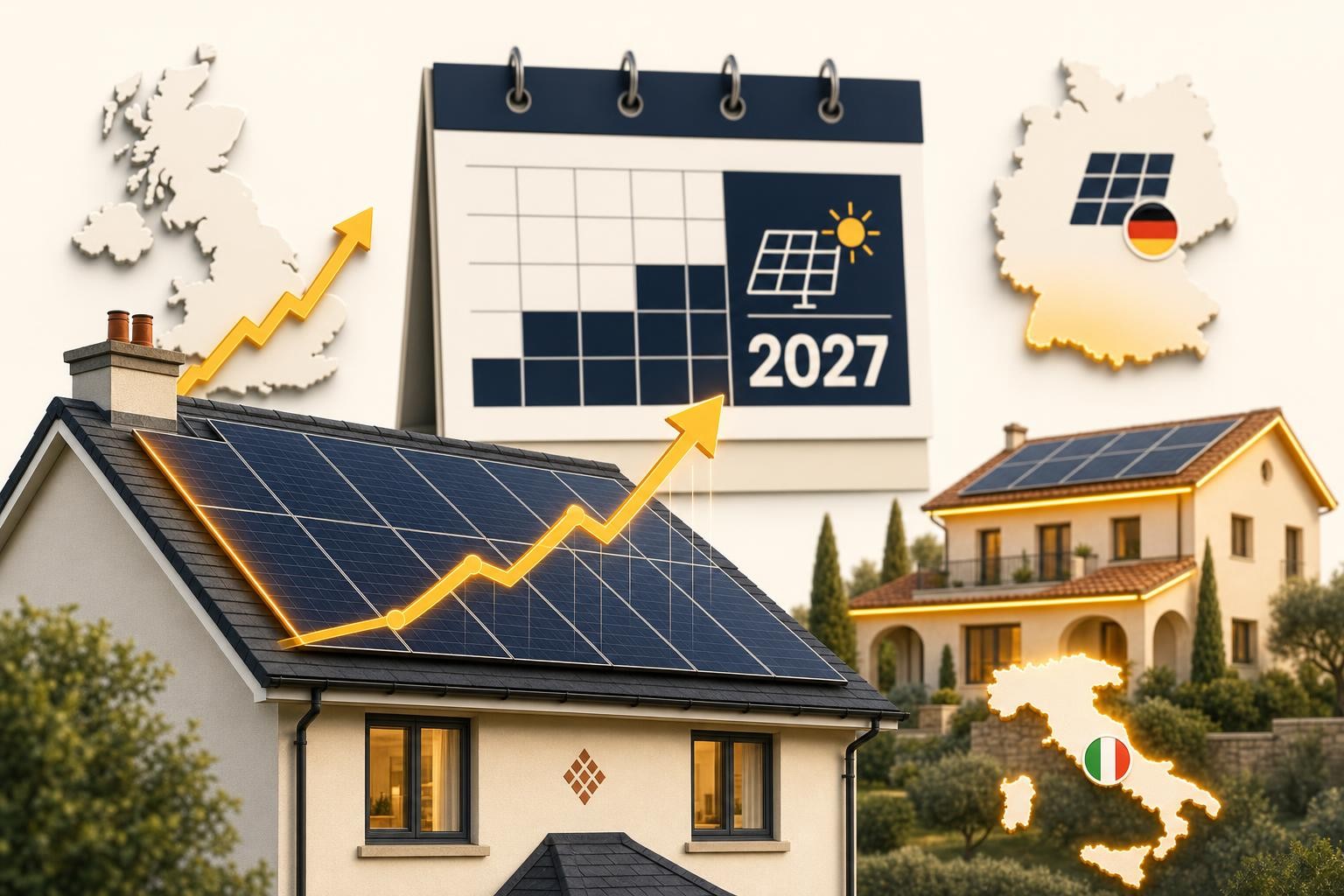
Three things happened in the solar world this week that every homeowner in the UK, Germany, and Italy should know about. Energy bills just got more expensive in Britain. Germany's guaranteed feed-in tariff is quietly counting down to a potential 2027 expiry. And Italy continues to offer the fastest payback of the three markets - if you know which incentives to stack. Here's the full picture.
UK: The 13% Bill Shock That Makes Solar More Compelling Than Ever
On 1 July 2026, the UK energy price cap rose 13%, pushing the annual bill for a typical dual-fuel household to £1,862. That's a £221 jump compared to the April-June quarter - and, according to the Energy Saving Trust, it is the largest overnight increase since April 2023.
The driver is geopolitical: rising wholesale gas prices, partly linked to disruption in Middle East shipping routes, fed straight through to UK electricity rates because gas-fired power stations still set the marginal price of electricity on the British grid. From 1 July, the capped electricity unit rate stands at 26.11p per kWh - a level not seen in a summer quarter since 2023.
The price cap is reviewed every three months. Analysts expect a further rise in October 2026. Every kWh you generate yourself is insulated from that repricing cycle.
What does this mean practically? A solar panel system reduces the share of your electricity that is subject to the cap. The more you self-consume, the less each quarterly reset affects your bill. Without a battery, a typical UK solar home self-consumes only 30-50% of what it generates - the rest is exported to the grid at a much lower rate. Add a correctly sized battery and that figure rises to 70-90%, meaning the majority of your generation is working at full retail value rather than being sold back cheaply.
For UK homeowners weighing up the numbers: a well-designed solar-plus-storage system now offers a payback period of 7-10 years, while providing a 25-year hedge against volatile energy prices. The 0% VAT on solar panels and battery storage for domestic properties remains in place until March 2027, which is a meaningful cost reduction on top of that.
Germany: The 2027 EEG Deadline You Shouldn't Ignore
Germany's Renewable Energy Sources Act (EEG) has guaranteed homeowners a fixed feed-in tariff for 20 years from the date their system is commissioned. That stability has been the backbone of the German solar boom. But the landscape is shifting.
A current legislative draft proposes that new PV systems commissioned from 2027 onwards may no longer receive a fixed feed-in tariff - instead, operators would sell electricity at spot market prices. For small rooftop systems, spot-market exposure is far more complicated and less predictable than a locked-in rate. Systems commissioned in 2026 are still eligible for the full 20-year guarantee at current rates.
The EEG also applies a built-in degression: feed-in tariff rates decrease by approximately 1% every six months, on 1 February and 1 August each year. Installing earlier locks in a higher rate for the entire 20-year period.
There's a second shift worth understanding: Germany's Solarspitzengesetz, which came into force in early 2025, suspends feed-in payments during 15-minute intervals when wholesale electricity prices turn negative. On sunny days, Germany's grid is increasingly overwhelmed at midday - in 2025, negative-price hours occurred for nearly 600 hours across the year. The policy response is to encourage homeowners to store that midday surplus rather than export it. The practical takeaway: a battery is no longer just a payback accelerator in Germany - it's becoming a structural part of getting the most from your system.
For German homeowners, the financial case stacks up clearly. A residential solar system in Germany has an average payback period of 8-12 years in 2026, supported by 0% VAT on solar equipment and high electricity prices of €0.30-0.38/kWh. The partial feed-in model - where you self-consume what you can and export the surplus - outperforms full feed-in for most households, because self-consumed electricity saves at the full retail rate (~€0.30/kWh) while exported electricity earns only around €0.078/kWh under the current tariff.
Italy: Still the Fastest Payback of the Three
Italy's solar economics are driven by two advantages that Germany and the UK can't match: significantly more sun and a 50% tax deduction (Detrazione Fiscale / Ecobonus) spread over 10 years.
Solar payback periods in Italy range from 5-8 years depending on region and incentives - with Southern Italy achieving payback in as little as 5-6 years. Compare that to 7-10 years in Germany and 8-12 years in the UK, and the gap is significant.
The Superbonus 110% - once the world's most generous residential solar subsidy - is closed for new standalone PV applications. What remains is the Ecobonus at 50-65%, which still halves the effective net investment when modelled over 10 years. A well-sited 6 kWp system in Rome generates roughly €1,400-€1,700 in annual bill savings. In Sicily or Puglia, where irradiance exceeds 1,800 kWh/m²/year, payback can be even shorter when EU-funded regional grants (FESR) are available.
Italy's output per installed kilowatt is 20-30% higher than Germany or the UK - which is why the same panel technology produces a faster return on a rooftop in Naples than in Manchester or Munich.
The Battery Question: Worth It in All Three Markets?
Across all three countries, the conversation has shifted from "should I get solar?" to "should I add a battery at the same time?" The answer is increasingly yes - but the reasoning differs by market.
- UK: With electricity at 26.11p/kWh and smart time-of-use tariffs available, a battery lets you charge cheaply overnight and discharge during peak hours. A 10 kWh battery combined with solar can deliver annual savings of £450-£750, with a payback period of 7-12 years. The 0% VAT relief on batteries runs until March 2027.
- Germany: The Solarspitzengesetz makes storage strategically important - batteries absorb midday surplus that would otherwise earn nothing (or less than nothing) during negative-price hours. Adding a 10 kWh battery typically extends solar-only payback by 2-4 years, but increases total system value by improving self-consumption and protecting against curtailment.
- Italy: Battery storage extends individual payback by 0.5-2 years but increases total system net present value, particularly in regions with high self-consumption potential. The Ecobonus 50% deduction can apply to battery storage as well as panels.
The universal principle: every kWh you self-consume saves at the full retail electricity price. Every kWh you export earns only the feed-in or export rate - almost always a fraction of what you pay to buy electricity back. Maximising self-consumption is the single biggest lever on payback across all three markets.
Know Your Numbers Before You Commit
The figures above are national or regional averages. Your actual payback depends on your roof's orientation and shading, your annual electricity consumption, your local grid tariff, and the precise size of system your roof can accommodate.
Trace your roof on a satellite map and get a personalised estimate of panels, system size, yearly output, savings, and payback — free, no sign-up required.
Try the free Solar Roof PlannerThe numbers are moving in one direction across all three markets: bills are rising, tariff guarantees are tightening, and the window to lock in the best incentives is narrowing. The homeowners who act in 2026 will look back on this as the right moment.