Weekly Solar Insights: What's Changing for Home Solar in Germany, the UK and Italy
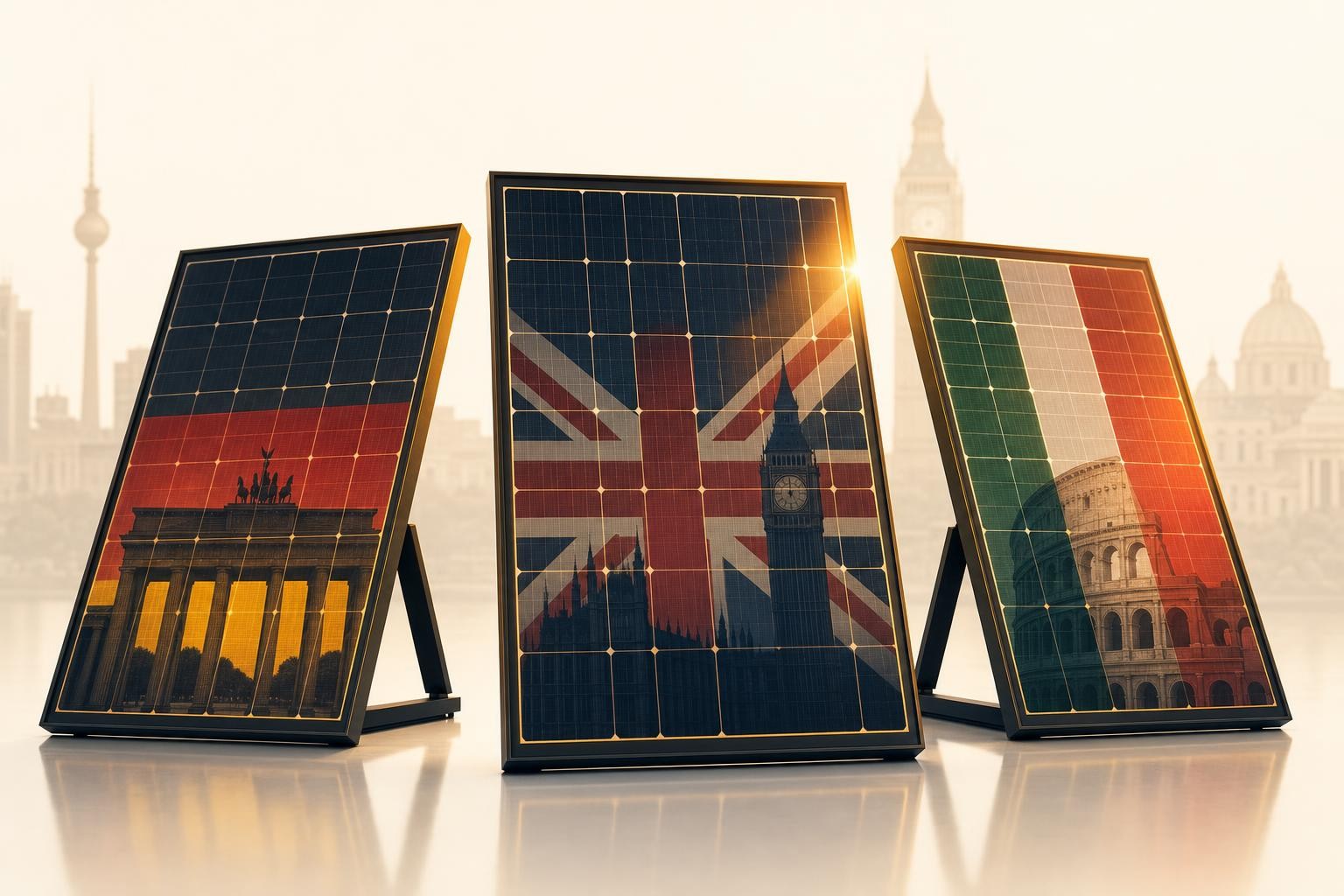
Welcome to this week's Solar Insights - a quick, friendly tour of the home-energy news that actually matters if you're weighing up solar for your own roof. This week there's real movement in all three of our markets, so here's what's changed and what it means for you as a homeowner.
Germany: 2026 is a good year to lock in today's rates
If you're in Germany and thinking about solar, there's a timing story worth knowing. Right now, a rooftop system up to 10 kW that exports its surplus earns a feed-in tariff of about 7.86 cents per kWh, or roughly 12.47 cents per kWh if you feed the entire output into the grid[1]. Those rates step down by 1% every February and August, so they gently drift lower over time.
The bigger news is further ahead. Under the current draft of the EEG reform, new PV systems from 2027 may no longer receive a fixed feed-in tariff at all - instead operators would sell their electricity at market prices. The practical takeaway is reassuring: a system commissioned in 2026 locks in today's guaranteed rate for the full 20 years. That's a solid reason not to keep putting the decision off.
One more recent change to be aware of: under the "Solar Peak Act" (Solarspitzengesetz), systems larger than 2 kW no longer earn compensation during hours when electricity exchange prices go negative[2]. If your system has a smart meter, those lost hours are simply added to the end of your 20-year support period, so you don't ultimately lose out.
United Kingdom: bills are up, and export payments are worth shopping around
British households just felt another squeeze: the July 2026 price cap rose to £1,862 a year, an increase of £221 or about 13.5%. Higher import prices sting - but they also make your own solar generation, and the payments you get for exporting surplus, more valuable than ever.
The gap between export deals is huge right now, so it pays to compare. Some of the strongest Smart Export Guarantee (SEG) offers include Good Energy at 25p/kWh as a flat rate with no battery required, and EDF's export exclusive at 24p/kWh. Households with a battery can go further - Octopus Intelligent Flux pays up to around 32p/kWh in peak export windows. Meanwhile, British Gas is cutting its SEG rate from 15.1p to 8p for larger systems[4], a reminder that not all tariffs move in your favour.
Two eligibility basics haven't changed: to claim SEG payments your installation needs MCS certification, and you effectively need a SMETS2 smart meter. No smart meter, no export income.
Italy: the main deductions are still here, but one door has closed
Good news for Italian homeowners: the 2026 Budget Law extended the familiar renovation tax deduction. You can claim 50% on a solar system installed on your primary residence, or 36% on a second home, up to a spending cap of €96,000 per property[7], recovered in equal instalments over 10 years. Domestic PV also still benefits from a reduced 10% VAT rate.
The one thing to note is that the "reddito energetico" grant fund - aimed at lower-income households - closed at the end of 2025, and there is no new window open for 2026[8]. And because the deduction works against your income tax, it's worth checking you have enough IRPEF to actually absorb the instalments before you count on the full 50%.
What this means for you
Across all three countries the theme is the same: electricity is expensive, the rules still reward homeowners who generate their own power, and the details - your roof, your bill, your usage - decide whether the numbers work. The averages in the headlines are only a starting point.
The easiest way to see your own real numbers is to trace your actual roof and let the maths run for your specific home. No pressure, no sign-up, no salesperson.
- Germany reduces feed-in tariffs for solar up to 1 MW
- Solarspitzengesetz: How it affects solar and negative pricing
- Feed-in Tariff Germany 2026
- British Gas SEG Rate Drops From 15.1p To 8p
- Best SEG export tariff rates UK – July 2026
- Compare UK Solar Tariffs - July 2026
- Incentivi 2026 per il fotovoltaico residenziale in Italia
- Incentivi Fotovoltaico 2026 | Enel