Time-of-Use and Dynamic Electricity Tariffs: Do They Actually Pay Off When You Have Solar?
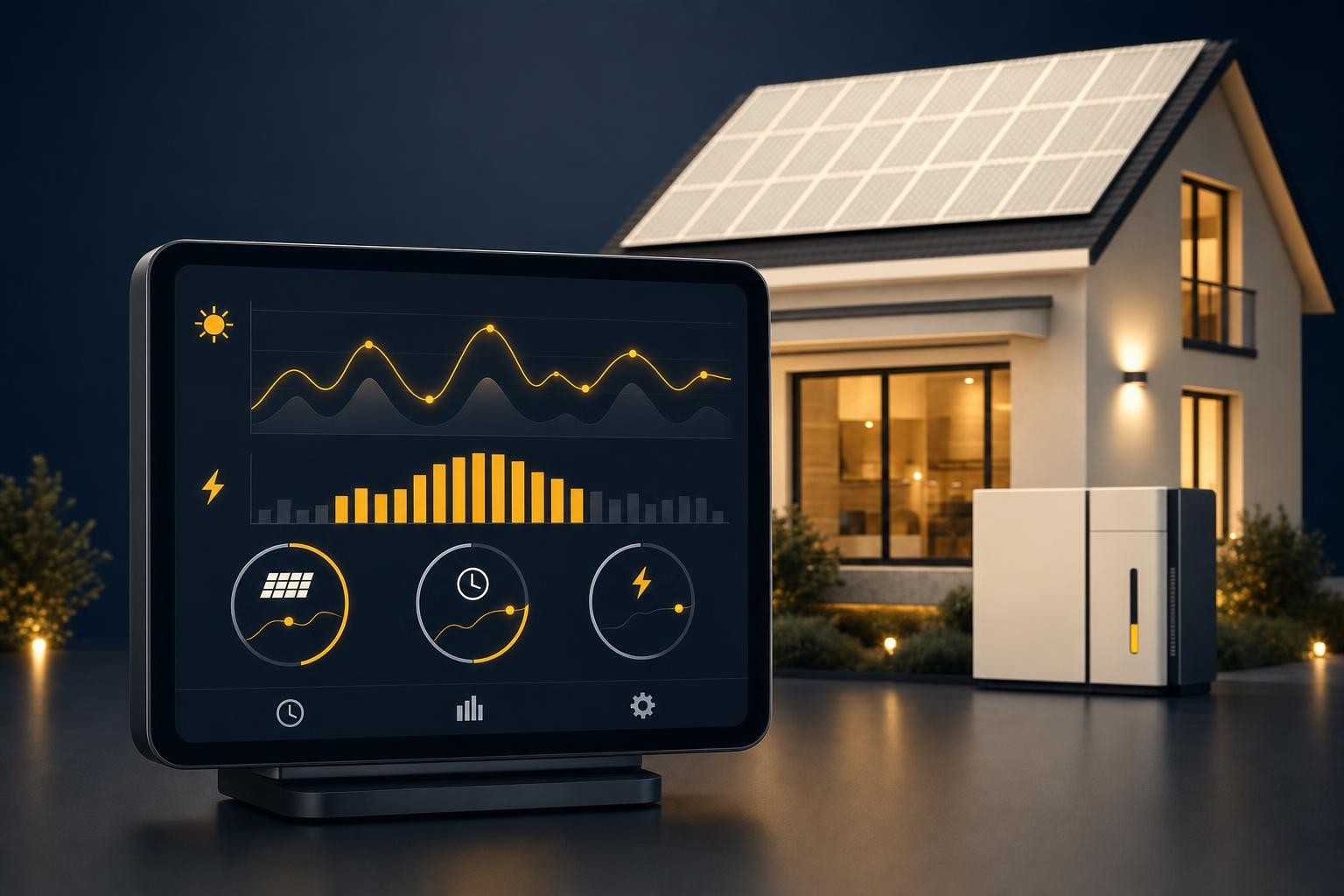
"Electricity that's cheaper at night" sounds like it was invented for solar households. Panels, battery, hourly prices, clever app - surely that's the dream combination?
Sometimes. But there's a catch that trips up a lot of people, and it's worth understanding before you switch anything.
The catch, in one sentence
A time-of-use or dynamic tariff only changes the price of the electricity you buy. It does nothing at all to the electricity you generate and use yourself.
That matters more than it sounds. On a sunny afternoon your panels are already covering the house, so you're buying almost nothing - and a clever tariff has nothing to work with. The hours when you are buying are early mornings, evenings and winter, which are exactly the expensive hours on most time-of-use tariffs.
So the honest rule is this: a dynamic tariff pays you back in proportion to how much electricity you can move in time. If you can't move anything, the price signal is just a price you can't act on.
The three kinds of tariff, quickly
Fixed / single rate. One price per kWh, all day. Boring, predictable, and still the right answer for a lot of households.
Time-of-use bands. A handful of fixed price windows - peak, off-peak, weekends. Italy's F1/F2/F3 system works this way, and so do most UK Economy 7 style tariffs.
Fully dynamic. The price follows the wholesale market, changing every hour or half-hour, published a day ahead. Cheap when it's windy and sunny at national scale, expensive at the 5pm demand peak.
The further down that list you go, the bigger the potential savings - and the more you have to engage.
What you actually need to make it work
Three things, in order of importance:
- A shiftable load. Something big that doesn't care when it runs: an EV charging overnight, a heat pump, a hot water tank, a home battery. Without at least one of these, there's very little to optimise. A dishwasher and a washing machine are worth a few tens of euros or pounds a year, not hundreds.
- A smart meter that measures by the hour or half-hour. Non-negotiable in all three countries.
- Some automation, or genuine patience. Manually checking prices every evening gets old fast. The households who do well on these tariffs almost always have something running the schedule for them.
Germany
Dynamic tariffs are now widely available, and you need an intelligentes Messsystem (a smart meter with a gateway) to be billed on hourly prices. Since 2025 you have the right to request one from your metering operator, with the cost capped at 20 euros a year[1].
The savings picture is refreshingly honest in the German data. A four-person household with no EV realistically saves something like 50 to 80 euros a year - real, but not life-changing. Add an EV and a heat pump and figures around 288 euros a year become plausible[2]. Finanztip's summary is blunt: a dynamic tariff is worth it if you have a heat pump or an electric car, while for households with normal or low consumption the cost risk outweighs the benefit[1].
Where it gets genuinely interesting is the full stack: solar, plus a battery, plus a dynamic tariff, plus a controller that charges the battery when prices are lowest[2]. That combination lets your battery do two jobs - storing your own sunshine and buying cheap grid power on dull winter days.
One thing not to confuse: your feed-in tariff is a separate matter. A dynamic tariff changes what you pay, not what you're paid for exports.
United Kingdom
The UK has the most developed market of the three, and the most important distinction is between import and export smart tariffs.
On the import side, Agile-style tariffs reprice every 30 minutes and publish the next day's prices the evening before. Overnight windows can drop to a few pence per kWh, while demand peaks can be several times the standard rate[3]. It's the highest-ceiling option and the one that most rewards automation.
On the export side, this is where solar households often do better. Flat Smart Export Guarantee rates currently top out around 15-16.5p per kWh on widely available deals, while time-of-use export tariffs can pay roughly 30p per kWh during the 4-7pm peak - though those headline rates generally assume you have a battery to discharge into that window[4].
The practical guidance is straightforward[3]:
- Solar only: the gain comes from shifting flexible appliances into cheap windows. Modest.
- Solar plus battery: now you can genuinely buy low and use high, and peak export rates come into play.
- Solar, battery and an EV charger: the most controllable loads, and the biggest case for a smart tariff.
Italy
Italy works on bands rather than hourly pricing for most households. F1 is the peak band, generally Monday to Friday from 8:00 to 19:00 excluding public holidays, with evenings and weekends falling into the cheaper F2 and F3[5]. You'll be offered monoraria (one price), bioraria or trioraria contracts; the three-band version is more common on the free market and rewards night-time consumption most[6].
Now here's the wrinkle that matters for solar owners, and it's a genuinely important one: self-consumed solar power sits outside the band structure entirely[6]. Your panels generate straight through the expensive F1 window, and every kWh they cover is simply not bought. In other words, Italian solar households are already capturing the biggest time-of-use benefit available to them, without any tariff at all.
Worth knowing too: as more solar comes onto the Italian grid, the price gap between the bands is gradually narrowing[6] - which quietly reduces how much a band-based tariff can save you.
The honest downsides
Nobody selling these tariffs leads with this list, so here it is:
- You carry the price risk. On a fixed tariff, spikes are the supplier's problem. On a dynamic one, they're yours.
- The savings need attention to be real. Modelled savings assume you actually respond to prices. Most people don't, most of the time.
- Standing charges don't move. Only the unit rate varies, so a chunk of your bill is unaffected.
- Winter is the test. Cold, still, dark evenings are when prices spike and when you're consuming most.
None of this makes dynamic tariffs a bad idea. It just means they're a tool for a specific job, not a universal upgrade.
So, should you switch?
Probably yes if: you have an EV, a heat pump or a home battery, a smart meter, and either automation or a genuine interest in tinkering.
Probably not yet if: your household consumption is modest, your big loads are inflexible, or the thought of watching electricity prices makes you tired. A good fixed rate and moving your washing to the middle of a sunny day will get you most of the benefit with none of the risk.
And in every case: the single largest saving on your bill isn't a tariff at all. It's the kWh you generate and use yourself, which costs you nothing at any hour of the day.
Start with the bigger number
Before optimising what you buy, it's worth knowing how much you might not have to buy at all.
Our free Solar Roof Planner lets you enter your address, trace your roof on a satellite map, and see a realistic estimate of panel count, yearly output, savings and payback - plus a straight answer on whether a battery would earn its keep on your roof, which is usually the thing that decides whether a smart tariff is worth your time.
No sign-up, no sales call, about five minutes.
{{cta:solar-roof-planner}}
Sources: Finanztip - dynamische Stromtarife, reduco.ai - dynamische Stromtarife 2026, Sunsave - is Agile Octopus worth it?, Uswitch - Smart Export Guarantee rates, Bolletta Energia - fasce orarie F1, F2, F3, Segugio - quale fascia oraria conviene.
- Dynamische Stromtarife: Voraussetzungen und Preise 2026 - Finanztip
- Dynamische Stromtarife 2026: lohnt das? - reduco.ai
- Agile Octopus: is it worth it? (UK, 2026) - Sunsave
- Smart Export Guarantee September 2026: find the best SEG rates - Uswitch
- Fasce orarie luce F1, F2, F3: orari, prezzi e quale conviene (2026)
- Fasce luce F1, F2, F3: qual e la piu economica - Segugio