Solar Panels and Home Insurance: What Homeowners in the UK, Germany, and Italy Need to Know
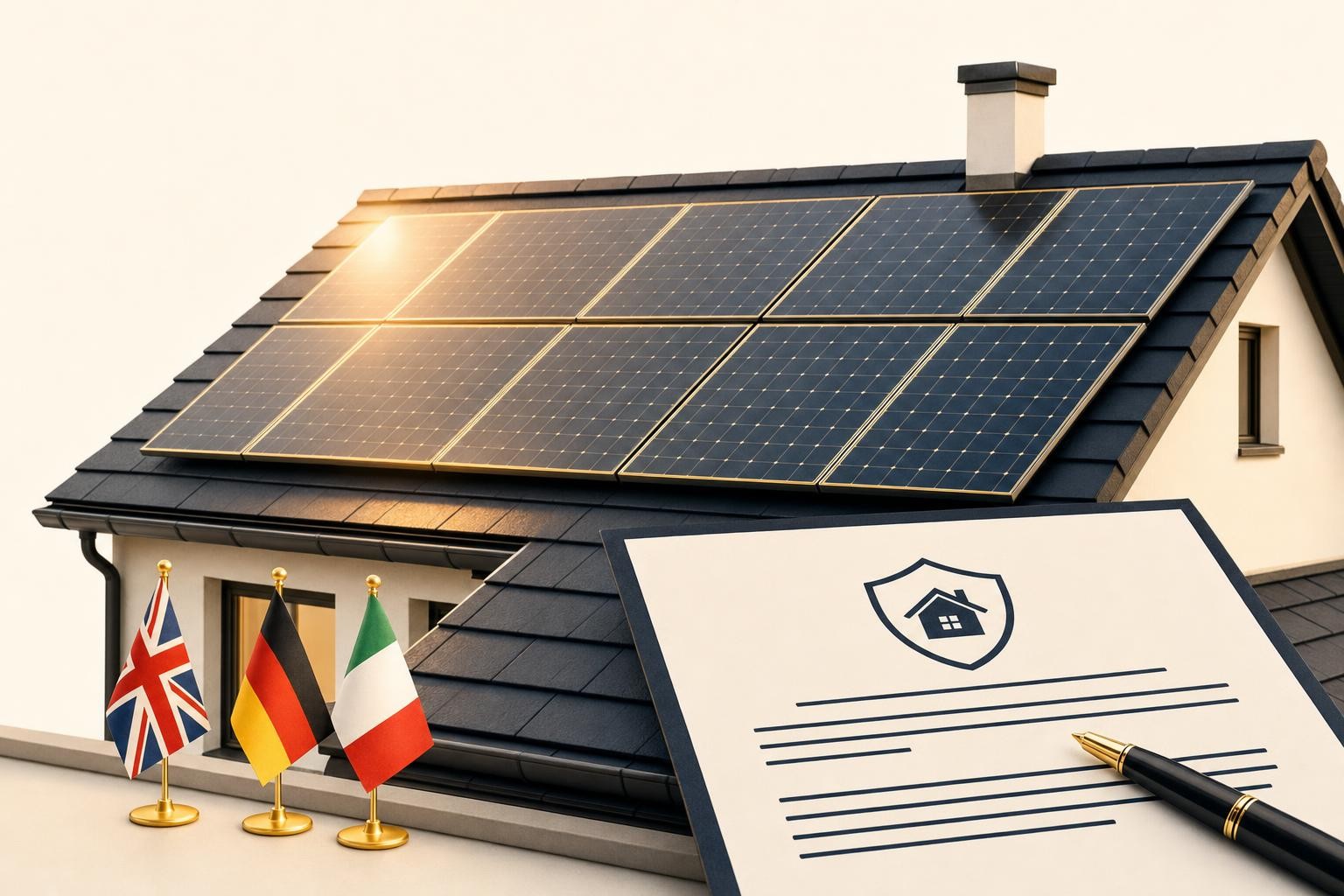
You've done the research, crunched the numbers, and decided solar makes sense for your home. Brilliant. But before the scaffolding goes up, there's one conversation most homeowners forget to have - the one with their insurer.
This guide walks through what you need to know in the UK, Germany, and Italy: what to report, what's covered, what isn't, and the handful of documents worth keeping safe. It's general information, not insurance advice - your own insurer is always the right person to confirm the specifics of your policy.
The Golden Rule: Tell Your Insurer Before Installation
Wherever you live, the single most important step is the same: contact your insurer before the panels go on the roof.
You must inform your home insurer that you have installed solar panels - in insurance terms, this is a material change in circumstances that affects your policy. Most insurers ask about this at renewal, but you should notify them immediately after installation, not wait until renewal.
Why does timing matter so much? Your insurer can refuse to pay out on any claim - not just solar-related claims - on grounds of non-disclosure. Your policy may be voided entirely, and in the event of a major claim such as fire, flood, or storm, your insurer has grounds to argue the risk they were covering was materially different from what was declared.
🇬🇧 United Kingdom: Buildings Insurance and a Few Extra Checks
What's covered (and what to update)
Solar panels are usually covered under standard buildings insurance, as they're considered a permanent part of the property. In many cases you don't need a specialist policy, and adding panels doesn't fundamentally change how your home is insured.
Major insurers including Aviva, Direct Line, and LV= treat panels as part of the building in the same way as a fitted kitchen or conservatory - they are covered for the same insured perils: fire, storm, flood, impact, theft, and vandalism.
The most common (and costly) mistake is forgetting to update your rebuild value. Solar panels are covered by buildings insurance because they're permanently fixed to the structure of your home - which means you need to make sure your policy has a high enough level of cover to include them. If your home's rebuild value was £250,000 and the solar installation cost £7,500, update the figure to at least £257,500. Under-insuring breaches most policy conditions and will reduce any payout proportionally.
Your insurer will also want to know who did the work. It should be an MCS-accredited installer. Your solar panels must meet British Standards and have an annual inspection - your insurer won't touch your solar panels if they aren't compliant or if they're not inspected every year.
Leasehold and mortgage considerations
If you own a leasehold flat or have a mortgage, there are a couple of extra hoops. If you live in a rented property or a leasehold, getting permission before installing is crucial. Skipping this step affects your liability and puts your insurance validity at risk - so get permission from your landlord or the freeholder in writing.
On the mortgage side, Halifax and Scottish Widows will not accept applications for leasehold flats where photovoltaic cells have been fitted, while NatWest will only accept applications if there is evidence that the installation was carried out by an MCS-certified company. If you're planning to remortgage or sell, check with your lender early.
Battery storage in the UK
If you have a solar battery added to your system, you'll need to talk to your insurance provider about whether this will be covered by buildings or contents insurance, depending on where it's kept. A battery in a garage or utility room may fall under a different part of your policy than one integrated into the house structure - worth a direct question before you sign anything.
🇩🇪 Germany: Wohngebäudeversicherung + Photovoltaik-Versicherung
The automatic-coverage myth
This is where many German homeowners get caught out. No, a PV system is not automatically covered. With most existing Wohngebäudeversicherungen, a retrospectively installed PV system is only insured once you have reported it to the insurer and had it added to the contract - usually for a surcharge of €35-120 per year. Without notification, you risk claim reductions or even complete loss of cover under §23 VVG (increased risk).
The insurer association GDV is clear: the existing protection of a Wohngebäudeversicherung generally does not extend to a PV system. Two routes lead to coverage: a PV add-on within the buildings policy, or a separate Photovoltaikversicherung.
Some newer tariffs do include small roof systems up to a certain output limit without extra charge - but whether yours is one of them is stated in your policy conditions under "Photovoltaik."
What a standard buildings add-on covers - and what it misses
In the Wohngebäudeversicherung, standard physical damage to the system from fire, water pipes, storm, hail, explosion, implosion, and overvoltage from a direct lightning strike is insured.
But that's where the standard cover stops. Buildings insurers often only cover standard risks like fire, storm, and hail. Technical defects, theft, operating errors, material faults, animal damage, and yield losses typically remain uncovered.
A dedicated Photovoltaikversicherung fills those gaps. A professional PV insurance policy should at minimum cover storm, hail, lightning, overvoltage damage, short-circuits, operating errors, theft, and vandalism. It can also include yield-loss cover - a classic Wohngebäudeversicherung does not cover yield losses, whereas a specialist PV policy replaces those lost earnings, including the additional cost of buying electricity from the grid.
German homeowners: Report your PV system to your Wohngebäudeversicherung in writing (email or letter) as soon as installation is confirmed. Keep a copy. Failure to report is treated as an increase in risk under §23 VVG and can lead to reduced or refused payouts — even for unrelated claims.
🇮🇹 Italy: Polizza Incendio/Fabbricato and the Responsabilità Civile Question
Does your existing polizza casa cover the panels?
In Italy, the starting point is your home fire/building policy (polizza incendio or polizza fabbricato). Not all polizze casa cover damage to photovoltaic or solar panels - you'll need to read the information set carefully and ask your insurer if in doubt.
Home policies typically include cover for damage caused by hail, wind, snow, and other adverse weather conditions, as well as fire and explosion damage, electrical faults, short-circuits and overvoltages, and theft and vandalism. But whether your impianto fotovoltaico is explicitly included in those perils is a question for your broker - not an assumption.
Adding the solar system and civil liability
When you add panels, ask your insurer to extend the policy to include the system explicitly. Also ask about responsabilità civile (RC). RC insurance covers damage caused by the photovoltaic system to third parties - for example, if a solar panel falls and damages a neighbour's property, the RC policy can cover the repair costs.
Dedicated photovoltaic policies offer more targeted cover: physical damage to panels and other components including inverters, batteries, and support structures, as well as compensation for production losses due to faults or covered damage.
Ground-mounted systems are more exposed to theft than those installed on the roof of a private home - if you're going ground-mounted, make sure your policy explicitly covers that installation type.
What's Covered vs. What Isn't (Across All Three Countries)
| Issue | Typically Insured? | Covered by Warranty? | Notes |
|---|---|---|---|
| Storm / hail damage to panels | ✅ Yes | ❌ No | Core peril in all three countries |
| Fire damage to system | ✅ Yes | ❌ No | Confirm panels are declared |
| Theft of panels | ✅ Usually (check policy) | ❌ No | DE: needs PV-Versicherung; IT: check RC |
| Short-circuit / overvoltage | ✅ Usually | ❌ No | DE: standard in Wohngebäude add-on |
| Panel degradation over time | ❌ No | ✅ Yes (performance warranty) | Normal wear — not an insured event |
| Manufacturer defect | ❌ No | ✅ Yes (product warranty) | Typically 10–25 years |
| Poor workmanship by installer | ❌ No | ✅ Yes (installer warranty) | Keep your commissioning paperwork |
| Yield / income loss | ⚠️ Only with specialist policy | ❌ No | DE: PV-Versicherung; IT: polizza dedicata |
| Scaffolding / removal for roof repair | ⚠️ Check policy wording | ❌ No | Often excluded — ask explicitly |
| Ground-mounted system | ⚠️ May need separate cover | Varies | Treat as 'other structure' in many policies |
The scaffolding question nobody asks
When your roof needs repair after a storm, the panels have to come off first - and that costs money. Scaffolding, panel removal, safe storage, and reinstallation can add significantly to a repair bill. A professional PV insurance policy should include coverage for the costs of dismantling, repair, and rebuilding the system when roof damage occurs. Ask your insurer directly: "If the roof beneath my panels is damaged in a storm, does the policy cover the cost of removing and reinstalling the panels?" Get the answer in writing.
Battery Storage: Five Questions to Ask Your Insurer
Home batteries are increasingly common - and they introduce a specific set of questions that most standard policy wording hasn't caught up with yet.
Battery systems store excess energy for later use, but they also introduce fire hazards. Lithium-ion batteries can overheat or fail if installed incorrectly. Insurers often require professional installation and may ask for proof of compliance with local codes. Improper setup can void coverage and warranties.
Before your battery goes in, ask:
- Is the battery covered under buildings or contents? (Depends on where it's installed.)
- Does the policy cover thermal runaway or battery fire specifically?
- Is professional installation by a certified electrician required for cover to apply?
- Does the battery need to be declared separately from the panels?
- Are there any exclusions for batteries installed in garages or basements?
The Documents Worth Keeping Forever
A solar installation generates a small stack of paperwork. Keep all of it - ideally in both digital and physical form.
- Invoice and proof of payment - establishes the system's value for insurance purposes
- MCS certificate (UK) / Inbetriebnahmeprotokoll (DE) / dichiarazione di conformità (IT) - proof of compliant installation
- Commissioning / handover report - confirms the system was tested and working on day one
- Installer warranty documents - separate from manufacturer warranties; covers workmanship
- Manufacturer product and performance warranties - typically 10-12 years for product, 25 years for performance
- Written confirmation from your insurer - that the system is covered and the sum insured has been updated
Photograph your installation on the day it's completed — panels, inverter, mounting hardware, and the meter reading. Store the photos with your insurance documents. If you ever need to make a claim, this evidence is invaluable.
Quick Checklist Before Your Panels Go On
Ask whether your current policy covers solar panels and what you need to do to add them. Get confirmation in writing.
Add the full installed cost of the system to your declared rebuild value. Underinsurance is the most common and costly mistake.
Each country has a different insurance structure. Confirm your system is explicitly named in the policy, not just assumed to be included.
If you're adding a battery, treat it as a separate declaration. Ask about fire risk, installation requirements, and which section of the policy applies.
Ask explicitly whether the cost of removing and reinstalling panels during a roof repair is included. If not, check whether a specialist PV policy covers it.
Invoice, installation certificate, warranties, and written insurer confirmation. You'll need them if you ever make a claim — or sell the house.
FAQ
Do I need a separate solar panel insurance policy?
In most cases, no — your existing buildings insurance (UK), Wohngebäudeversicherung with a PV add-on (Germany), or polizza incendio/fabbricato with an explicit extension (Italy) is sufficient. A specialist policy becomes worth considering if you have a large system, want yield-loss protection, or can't get written confirmation of cover from your current insurer.
What happens if I don't tell my insurer?
Your insurer can reduce or refuse payouts — not just for solar-related claims, but potentially for any claim, on the grounds that you failed to disclose a material change. In Germany, this is specifically governed by §23 VVG. In the UK, it can void your policy entirely.
Are ground-mounted panels covered the same way as roof-mounted ones?
Not always. Ground-mounted systems are often treated as a separate structure and may not be automatically included in a standard buildings policy. They also tend to be more exposed to theft. Check your policy wording explicitly, and consider a standalone PV policy if cover isn't confirmed.
My installer offers insurance — is that enough?
Installer-offered policies (increasingly common in Italy and Germany) can be excellent, but read the small print. Check what perils are covered, whether yield loss is included, and whether the policy sits alongside or replaces your home insurance obligations. Always notify your home insurer regardless.
Does panel degradation count as an insured loss?
No. Gradual degradation in output over time is a normal characteristic of solar panels and is not an insured event. It's covered by the manufacturer's performance warranty — typically guaranteeing at least 80% of rated output after 25 years. Keep that warranty document safe.
What about during installation — am I covered if something goes wrong?
Your buildings insurance covers the structure of your home, but damage caused during installation is typically the installer's responsibility under their own public liability insurance. Ask your installer for proof of their liability cover before work begins.
One Last Thing Before You Call Your Insurer
If you haven't yet worked out the size of system you need - or you're still deciding whether solar makes sense for your home - that's a useful first step. Knowing your system's output, value, and kWp makes the insurance conversation much more straightforward.
Trace your roof on a satellite map and get an instant estimate of panel count, annual output, and system value — the numbers your insurer will ask about. Free, no sign-up needed.
Try the free Solar Roof PlannerThis article is general information only and does not constitute insurance advice. Always speak to your insurer or a qualified insurance broker about your specific policy and circumstances.