Solar Panel Types Explained: A Plain-English Guide for Homeowners
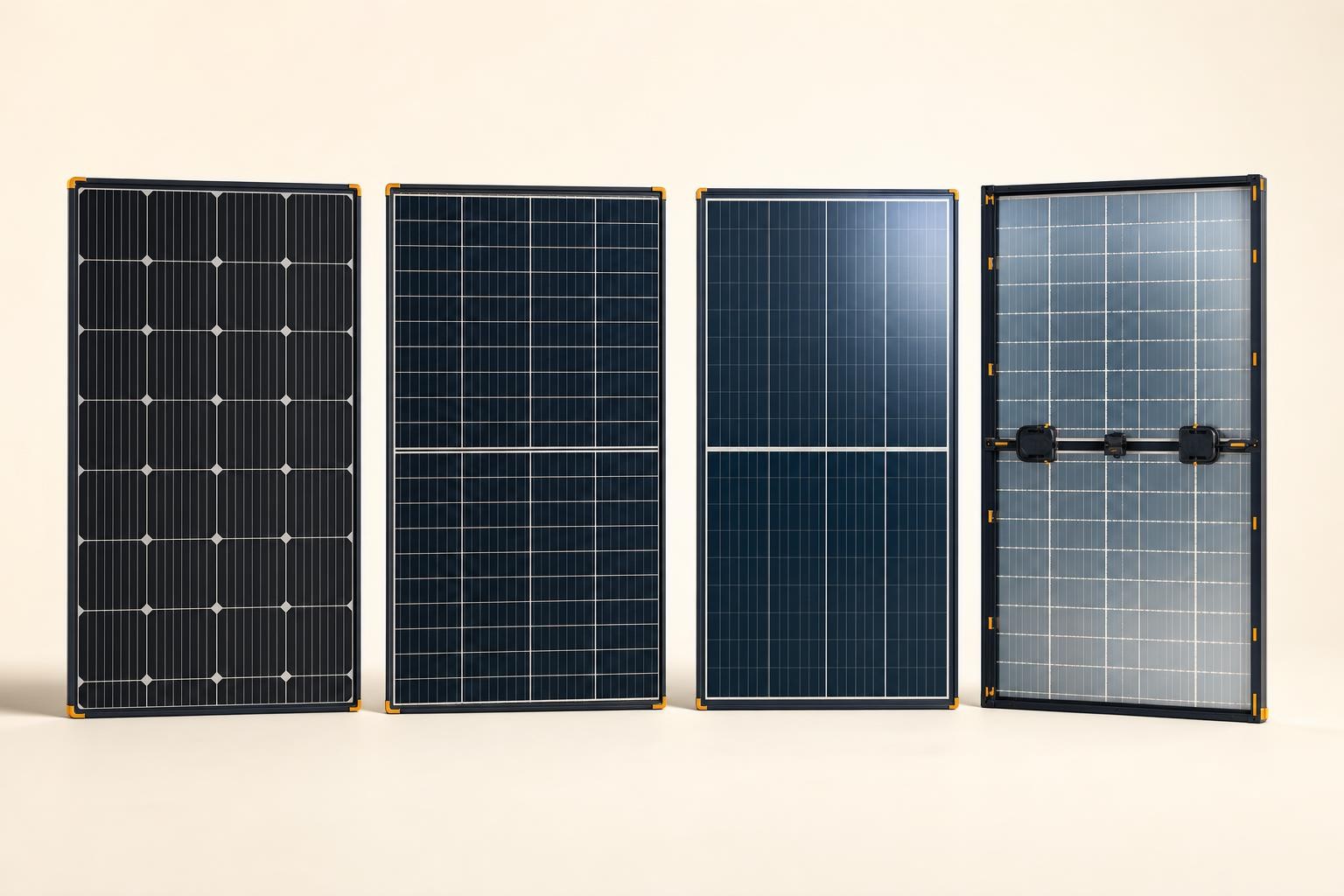
Walk into any solar quote and you'll be hit with a wall of acronyms: TOPCon, HJT, PERC, bifacial, back-contact. Most of it sounds like it belongs in a physics lecture, not a conversation about your roof. This guide cuts through all of it - no jargon, no brand cheerleading, just what you actually need to know to have a confident conversation with your installer.
Step one: forget polycrystalline
If you've done any research, you may have come across "blue" solar panels - the ones with a speckled, blue-ish look. Those are polycrystalline panels, made by melting silicon fragments together into a mould. The grain boundaries between crystals slightly impede electron flow, which is why they're less efficient.
Monocrystalline panels now account for roughly 98% of new residential installations, with polycrystalline effectively exiting the market. The price gap between the two technologies has narrowed to just 10-20%, making monocrystalline's efficiency advantage a clear winner for most homes. You're very unlikely to be offered a polycrystalline panel by a reputable installer today - but if you are, ask why.
The colour difference, by the way, is purely a manufacturing side-effect. The blue anti-reflective coating on poly panels helps them absorb more light; mono panels are naturally very absorbent and appear dark or black. The colour itself tells you nothing about quality beyond the cell type underneath.
The three technologies you'll actually encounter: PERC, TOPCon, HJT
All modern residential panels are monocrystalline. The real choice is which generation of mono technology you're getting.
PERC (Passivated Emitter and Rear Contact) was the residential workhorse from around 2018. It adds a reflective layer to the back of the cell so unabsorbed light gets a second pass. PERC panels typically achieve 20-22% efficiency and are still available at the lowest price point. PERC fell from 60% of global production in 2023 to about 14% of modules shipped worldwide in 2025, as manufacturers rapidly shifted to TOPCon.
TOPCon (Tunnel Oxide Passivated Contact) is the current mainstream standard. It uses an ultra-thin silicon oxide layer on the rear to dramatically reduce electron losses. By the end of 2025, TOPCon accounted for roughly 80% of all new solar cell production capacity installed worldwide. Commercial TOPCon modules achieve 22-25% efficiency - meaningfully more power from the same roof space - at only a 10-15% cost premium over PERC. For most homeowners, TOPCon is the sweet spot.
HJT (Heterojunction Technology) combines crystalline silicon with thin amorphous silicon layers on both sides, creating exceptional passivation. It achieves 23-25% efficiency in mass production and has the best temperature performance of any silicon technology currently at scale. The catch: it costs 30-50% more than equivalent PERC panels. HJT makes sense when your roof is tight on space, or if you're in a hot climate like southern Italy where panels regularly get very warm.
Back-contact panels (sometimes called IBC) move all the electrical contacts to the rear of the cell, eliminating shading from front-side busbars. They're the most efficient silicon panels available commercially, but also the most expensive. Think of them as the premium-premium option - worth considering only if roof space is genuinely critical and budget isn't.
All-black vs standard look: does it affect output?
The "all-black" panel - black cells, black frame, black backsheet - is popular for aesthetics, and for good reason: on a dark roof it blends in beautifully rather than looking like industrial equipment bolted to your house.
The honest answer on performance: the colour of the frame and backsheet has a tiny effect. A white backsheet reflects a small amount of light back through the cell, giving a marginal efficiency boost. An all-black backsheet absorbs that light as heat instead. One real-world test found an all-black panel running about 4°C hotter than an equivalent standard panel, producing roughly 1.1% less output on a warm afternoon. That's a real but very small difference - well within the noise of day-to-day weather variation.
Most homeowners pay a 5-10% premium for the all-black look. The energy maths doesn't justify it on its own, but if aesthetics matter to you, it's a perfectly reasonable choice. Just don't let anyone tell you all-black panels are more efficient - the cell technology is what drives efficiency, not the frame colour.
Efficiency, wattage and price per kWp - what to actually compare
These three numbers get muddled constantly. Here's the quick version:
- Efficiency is the percentage of sunlight converted to electricity. Higher efficiency = more watts from the same area of roof.
- Wattage (e.g. 420 W, 440 W) is the panel's output under ideal lab conditions. A useful shorthand for size.
- Price per kWp is the fairest comparison across different panel sizes - it's the installed cost divided by the total system capacity in kilowatts-peak.
When comparing quotes, always ask for the price per kWp installed. A cheaper panel that needs two extra panels to hit the same system size isn't necessarily cheaper overall.
Temperature coefficient: the spec that matters more in summer
Panels are tested at 25°C in a lab. Your roof in July is not 25°C. Real rooftop temperatures can reach 65-75°C on a hot summer day. The temperature coefficient tells you how much output drops for every degree above 25°C.
- PERC: around -0.35%/°C
- TOPCon: around -0.30-0.32%/°C
- HJT: around -0.24-0.26%/°C
At a cell temperature of 65°C, HJT holds roughly 4 percentage points of output over PERC and about 2 points over TOPCon. If you're in southern Germany, central Italy, or anywhere that gets proper summer heat, this number is worth paying attention to.
Degradation and warranties: what the paperwork actually means
Every panel loses a little output each year - this is called degradation. According to NREL research, the median degradation rate across modern photovoltaic panels is about 0.5% per year, meaning a quality panel producing 400 W today will still generate around 340 W after 30 years.
Technology matters here too:
- Standard PERC: ~0.5%/year
- TOPCon: ~0.35-0.45%/year
- HJT: ~0.25-0.35%/year - the best of any mass-produced silicon technology
Your panel comes with two separate warranties - and most homeowners conflate them:
- Product warranty (typically 10-25 years): covers manufacturing defects, delamination, frame failures.
- Performance warranty (usually 25 years): guarantees minimum output. Premium manufacturers now commonly guarantee 87-92% of original output at year 25.
Watch out for the fine print. A warranty that only guarantees "80% at year 25" with no annual floor is very different from one that guarantees "no more than 0.4% decline per year from day one." The first lets a panel drop sharply in year two and still technically pass. The second protects you throughout. Many panels also lose 1-2% in the first year due to light-induced degradation (LID) - a one-time settling effect when silicon is first exposed to sunlight. N-type technologies (TOPCon and HJT) are largely immune to LID, which is another mark in their favour.
Bifacial panels: clever technology, wrong roof
Bifacial panels generate power from both sides - front and back. At utility scale, over bright gravel or white ground, they routinely add 5-15% annual energy. On your pitched roof, the story is very different.
On a typical flush-mounted dark roof, monitored systems show bifacial gains of only 2-5% - frequently below the 10-20% premium still attached to residential-grade bifacial modules. The rear of each panel faces the roof surface just centimetres away, so there's no reflective gap for the back side to harvest.
The honest rule: skip bifacial for a standard pitched roof. Consider it only if you're installing on a flat roof with tilt frames, a carport, a pergola, or a ground mount over light-coloured gravel or concrete - where the rear side can actually see reflected light.
The decision checklist
Here's the short version if you prefer:
| Your situation | Best move |
|---|---|
| Limited roof space | Prioritise efficiency - TOPCon minimum, HJT if budget allows |
| Big roof, flexible budget | Reliable TOPCon from a tier-1 brand; save money on price per kWp |
| Hot climate (southern Italy, etc.) | HJT's lower temperature coefficient pays back over time |
| Partial shading | Any good panel + power optimisers or microinverters (see our shading guide) |
| Bifacial panels offered? | Only worthwhile on flat roofs with tilt frames or ground mounts |
The honest truth: the panel is not the most important decision
This is worth saying plainly. The difference between a good PERC panel and a good TOPCon panel is real but modest - a few percentage points of annual output. The difference between a well-designed, well-installed system and a poorly designed one can be 20-30%.
Your installer's system design, cable routing, inverter choice, and ongoing support matter far more than whether you chose TOPCon or HJT. A great installer with a mid-range panel will outperform a careless one with a premium panel every time. We cover how to evaluate installers in our installer guide - it's worth a read before you start collecting quotes.
When comparing quotes, ask each installer: What is the price per kWp installed? and What is the panel's warranted annual degradation rate? Two numbers that cut through the marketing noise faster than any spec sheet.
Ready to see what your roof can actually do?
Once you know your panel type, the next question is: how many panels fit, and what will they generate? Our free Solar Roof Planner lets you trace your roof on a satellite map and get a personalised estimate - panels, kWp, yearly output, savings, and payback - in a few minutes. No sign-up, no sales call.
Trace your roof on a satellite map and get panels, kWp, yearly output, savings and payback — free, no sign-up.
Try the free Solar Roof PlannerIs TOPCon better than PERC for a UK home?
For most UK homes, yes. TOPCon panels deliver 22–25% efficiency versus PERC's 20–22%, degrade more slowly, and are immune to light-induced degradation. The price premium is now only 10–15% over PERC, making TOPCon the better long-term value in almost every scenario.
Do black solar panels produce more electricity than blue ones?
The black colour itself doesn't produce more electricity — the underlying cell technology does. Black panels are monocrystalline (higher efficiency); blue panels are polycrystalline (lower efficiency). Within the same cell technology, an all-black backsheet can actually run slightly hotter and produce marginally less than a white-backsheet version of the same panel.
What does 'kWp' mean?
kWp stands for kilowatt-peak — the maximum power output of a solar system under standard test conditions (full sun, 25°C). A 5 kWp system in Germany typically generates around 4,500–5,500 kWh per year, depending on roof orientation and shading.
How long do solar panels actually last?
Most tier-1 panels carry a 25-year performance warranty and will keep producing electricity well beyond that. NREL data shows the median degradation rate is around 0.5% per year, meaning a quality panel still delivers roughly 85–90% of its original output at year 25 — and keeps going.
Are bifacial panels worth it for a standard pitched roof in Germany or Italy?
Rarely. On a flush-mounted pitched roof, bifacial gains are typically only 2–5% — not enough to justify the 10–20% cost premium. Save bifacial for flat roofs with tilt frames, carports, or ground mounts where the rear side can actually see reflected light.