Do You Need Permission to Put Solar on Your Roof? The Paperwork Explained for Germany, the UK and Italy
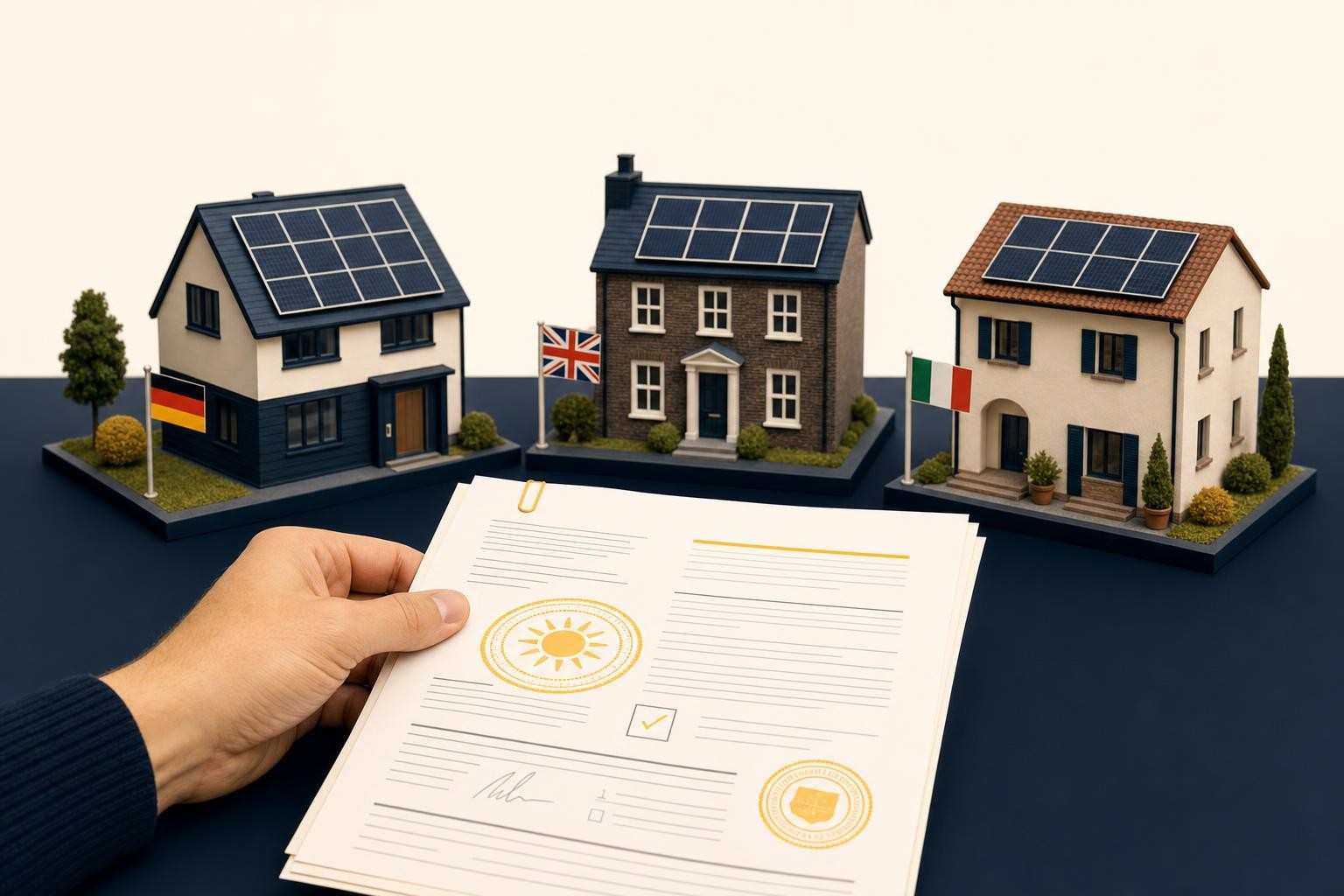
If the thought of council forms and grid operators is quietly putting you off solar, here's the reassuring news up front: for the vast majority of ordinary homes in Germany, the UK and Italy, you do not need planning permission to put panels on your own roof.
What you do need is paperwork. And that's the bit nobody explains properly, so let's fix that. Below is what actually has to be registered, notified or approved in each country, when it has to happen, and - importantly - which parts your installer normally handles for you.
The one rule that's true everywhere
"No permission needed" is not the same as "nothing to do".
In all three countries, a grid-connected solar system has to be known about by the people who run the electricity network. That's not a bureaucratic formality: it's how the grid stays balanced and safe, and in Germany and Italy it's also how you get paid for the power you export. Skip it and you can genuinely lose money.
The second universal rule: heritage and conservation change everything. Listed buildings, protected townscapes and historic centres have their own rules in every one of these markets, and they're the single most common reason a straightforward job turns into an application.
United Kingdom
Planning permission: usually not needed. Roof-mounted panels on a house count as permitted development in England under Part 14 of the General Permitted Development Order[1]. The current limits are generous: panels may project up to 300mm from the roof plane, and the array can cover up to 70% of the roof area[1]. The equipment also has to be sited to minimise its visual impact as far as practicable, and removed when no longer needed.
When you do need an application:
- The building is listed or a scheduled monument
- Panels would go on a wall fronting a highway in a conservation area or World Heritage Site
- You'd exceed the projection, height or coverage limits
- Your council has issued an Article 4 Direction, which withdraws permitted development rights in sensitive areas[2]
Ground-mounted arrays have their own allowance: broadly up to 9 square metres, no more than 4 metres tall, at least 5 metres from the boundary, and only one standalone installation per property[1].
The paperwork that always applies. Your installer notifies the local network operator (a G98 or G99 application, depending on system size), issues a Building Regulations compliance certificate for the electrical and structural work, and - if you want to be paid for exported power under the Smart Export Guarantee - registers the system as MCS-certified. In practice a reputable installer does all of this. Your job is to check that the MCS certificate actually arrives, because without it, no supplier will pay you an export tariff.
Scotland, Wales and Northern Ireland have their own planning systems with broadly similar but not identical rules, so check with your local authority if you're outside England.
Germany
Germany is the country where the paperwork genuinely matters, so it's worth being precise.
Building permission (Baugenehmigung): normally not required for panels mounted parallel to an existing pitched roof. Building law is set by each Bundesland, so the details differ, and listed buildings (Denkmalschutz) are a real exception - those need approval from the heritage authority before anything goes up.
The three steps that always apply:
- Grid connection request, before installation. The Anschlussbegehren goes to your network operator ahead of the mounting date, and you should allow at least four weeks; the operator has up to eight weeks by law for the technical grid check[3]. They also have to give you a timetable within one month.
- Marktstammdatenregister within one month. Every grid-connected system must be registered in the Bundesnetzagentur's market data register within one month of commissioning[3]. A battery has to be registered separately. Miss the deadline and your claim to the feed-in tariff can be reduced or lost entirely[3] - this is the single most expensive mistake homeowners make, and it's completely avoidable.
- Commissioning report to the grid operator. Your electrician arranges the Inbetriebnahmeprotokoll, and only once that plus your registration confirmation reach the network operator does your entitlement to payment actually begin[3].
The tax office. Good news here. Since 1 January 2023, most small system owners no longer need to notify the Finanzamt or complete the tax registration questionnaire, provided three conditions all apply: the income tax exemption applies, the zero VAT rate was used on purchase, and you use the small business rule[3]. Since 2025 the income tax exemption covers building-mounted systems up to 30 kWp per residential or commercial unit[3]. Most family homes comfortably qualify.
Renting or a flat? A Balkonkraftwerk is far simpler: for plug-in devices within the EEG special rules (up to 2 kW of panels and 800 VA of inverter output), a simplified market register entry is enough and no separate grid operator notification is required[3]. You will still need your landlord's or the owners' association's agreement for the mounting itself.
Italy
Permission: usually none. Almost all residential rooftop systems fall under edilizia libera, meaning no building permit is required, as long as the array sits on an existing roof, doesn't alter the structure, and the property isn't subject to special constraints[4].
The Modello Unico does the heavy lifting. This single standardised form replaces the other communications for systems up to 200 kW, and your installer normally files it[5]. Larger or more complex rooftop work may still require a CILA notification[5].
The constraint to check first. If your home sits in a historic centre or under a landscape protection order (vincolo paesaggistico), you may need a preliminary check, a nullaosta, or full landscape authorisation from the Soprintendenza[4]. This is the one thing worth confirming before you sign anything, because it affects both timeline and design.
And the reminder that catches people out: "no authorisation" does not mean "no obligations". The grid connection paperwork, the declaration of conformity for the installation, and the Modello Unico all remain mandatory[4].
A simple checklist before you sign
Whichever country you're in, these five questions will tell you almost everything:
- Is my building listed, in a conservation area, or under a heritage or landscape constraint? If yes, ask about approvals before anything else.
- Will the panels sit flat against an existing roof? If yes, you're almost certainly in the simplest category.
- Who files the grid paperwork - me or the installer? Get this in writing. It should be them.
- What are the deadlines after switch-on, and who is responsible for meeting them? In Germany this is the one-month register deadline; in the UK it's your MCS certificate; in Italy it's the Modello Unico.
- Am I an owner, or do I need someone else's agreement? Landlords, freeholders and owners' associations all have a say.
Rules do change, and local authorities interpret them differently, so treat this as a solid orientation rather than legal advice - a quick call to your local planning office or network operator costs nothing.
First, though: is your roof even a good candidate?
All of this paperwork only matters if the panels make sense in the first place. Before you start ringing planning departments, it's worth spending five minutes finding out what your roof could realistically produce.
Our free Solar Roof Planner lets you enter your address, trace your roof on a satellite map, and get an honest estimate of how many panels fit, what they'd generate each year, what you'd save, and roughly how long the payback would take. No sign-up, no sales call, no pressure.
{{cta:solar-roof-planner}}
If the numbers look good, then the forms are worth your afternoon.
Sources: SolarInfo UK - solar panel planning permission, Infinity Energy - planning permission for solar panels, Solaranlage Ratgeber - PV-Anlage anmelden, MET - fotovoltaico senza autorizzazione 2026, Reonic - permessi fotovoltaico 2026.
- Solar Panels Planning Permission UK 2026: Rules and Permitted Development
- Planning Permission for Solar Panels: Ultimate UK Guide (2026)
- Photovoltaikanlage Anmeldung: Netzbetreiber und Marktstammdaten - Solaranlage Ratgeber
- Fotovoltaico senza autorizzazione: regole 2026 per tetti e vincoli
- Permessi Fotovoltaico 2026: CILA, PAS e Autorizzazioni Complete