How to Read Your Electricity Bill (and Find the Numbers That Actually Cut Your Costs)
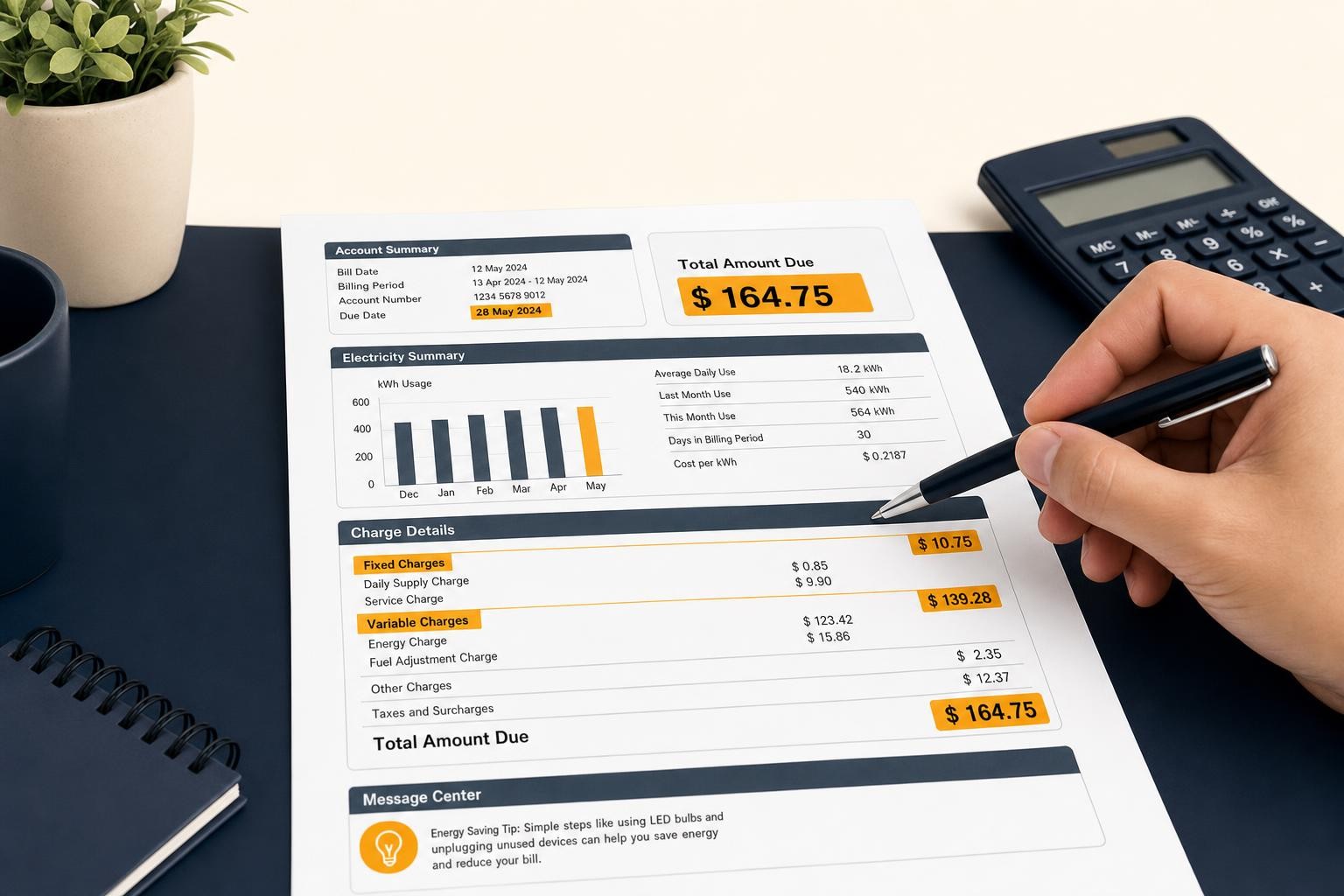
Most people look at exactly one number on their electricity bill: the amount they owe. That is understandable, and it is also why so much money quietly leaks away. Almost everything useful on that bill lives in the small print, and once you know which four or five figures matter, the whole thing takes about ten minutes a year to check.
Here is what to look for, wherever you live.
The two numbers that drive everything
Nearly every electricity bill in Europe is built the same way: a fixed charge you pay just for being connected, plus a variable charge for each unit of electricity you use.
In Germany these are the Grundpreis (fixed) and the Arbeitspreis (per kWh). In the UK they are the standing charge (charged per day) and the unit rate (per kWh). In Italy the fixed and variable elements are split across several regulated line items, which we will come to.
The variable charge is the one solar panels reduce. The fixed charge you pay regardless. That distinction matters more than people expect: a home with panels still pays its standing charge, so anyone promising you a zero bill is overselling.
Germany: where your 36 cents actually goes
German households pay somewhere around 36 ct/kWh on average in 2026[1]. That price splits into three fairly stable buckets: about 41.3% for generating and supplying the electricity, about 24.8% for the grid, and about 33.9% in taxes and levies[2].
There was some good news at the start of the year. Grid fees fell 15.4% nationwide in early 2026, thanks to a 6.5 billion euro federal subsidy to network operators, worth up to 100 euros a year for a typical household[3].
What to check on your bill: your Arbeitspreis in ct/kWh, your Grundpreis per year, your annual consumption in kWh, and the end date of your current tariff. If your supplier has quietly moved you onto a standard tariff after a fixed deal expired, that is usually the single most expensive thing on the page.
UK: the standing charge is bigger than you think
In the UK the price cap sets a maximum unit rate and standing charge. For the April to June 2026 period, the capped electricity unit rate was 24.67p/kWh with a daily standing charge of 57.21p[4]. From 1 July the cap for a typical direct-debit household moved to £1,663 a year[5].
That standing charge deserves attention, because the UK's is the highest in Europe at roughly £195 a year[6]. You pay it whether you use any electricity or not. It is also why households who are certain they barely use any power sometimes find their bill stubbornly high anyway.
What to check on your bill: your unit rate, your daily standing charge, whether you are on a fixed tariff or the capped default, and your annual kWh. Also check whether your most recent reading was actual or estimated. An estimate that runs high will quietly inflate your direct debit for months.
Italy: four regulated components, only one of which you can shop for
The Italian bill is the most transparent of the three once you know the vocabulary. ARERA splits it into four parts. In the first quarter of 2026, for protected vulnerable customers, those were spesa per la materia energia at 13.75 cents/kWh, or 49.2% of the bill, trasporto e gestione contatore at 6.18 cents, oneri di sistema at 3.03 cents, and commercializzazione at 2.24 cents[7], with taxes making up the remainder.
Here is the part worth internalising: only the materia energia component varies between suppliers on the free market[8]. Transport, system charges and taxes are set by ARERA and are identical everywhere. So when a salesperson promises a dramatically cheaper bill, they can only really be talking about half of it.
What to check on your bill: the materia energia rate, your annual kWh, whether you are on the mercato libero or maggior tutela, and your contracted power level in kW. Plenty of Italian homes pay for more contracted power than they ever actually draw.
The one calculation worth doing yourself
Whatever country you are in, do this. Take your total annual bill, including every fixed charge and every tax, and divide it by your annual kWh.
That is your real, all-in price per kilowatt-hour. It is almost always higher than the headline unit rate your supplier advertises, and it is the correct number to use whenever you are weighing up an energy upgrade. It is also the number solar competes against, because every kilowatt-hour you generate and use yourself is one you never buy at that price.
Where to go from here
Once you know your annual consumption and your true price per kWh, you have everything you need to work out whether generating some of your own power makes sense for your home.
Whenever you are ready, enter your address and trace your roof with the free Solar Roof Planner. It will show you a realistic estimate of how many panels fit, how much they would produce each year, and what that is worth at your electricity price. No sign-up, no sales call, just your own numbers.
- Germany's Energy Prices in 2026
- Strompreis-Zusammensetzung 2026 in Deutschland
- Strompreis aktuell 2026: Entwicklung und Ausblick
- Energy price cap unit rates and standing charges | Ofgem
- Energy price cap will rise by 13% from July | Ofgem
- Cost of Electricity in Europe: Prices, Trends and Ways to Save in 2026
- ARERA: Elettricita, Maggior Tutela I trimestre 2026
- Bolletta luce: voci, importi e come leggerla (2026)