How Many Solar Panels Does Your Home Actually Need?
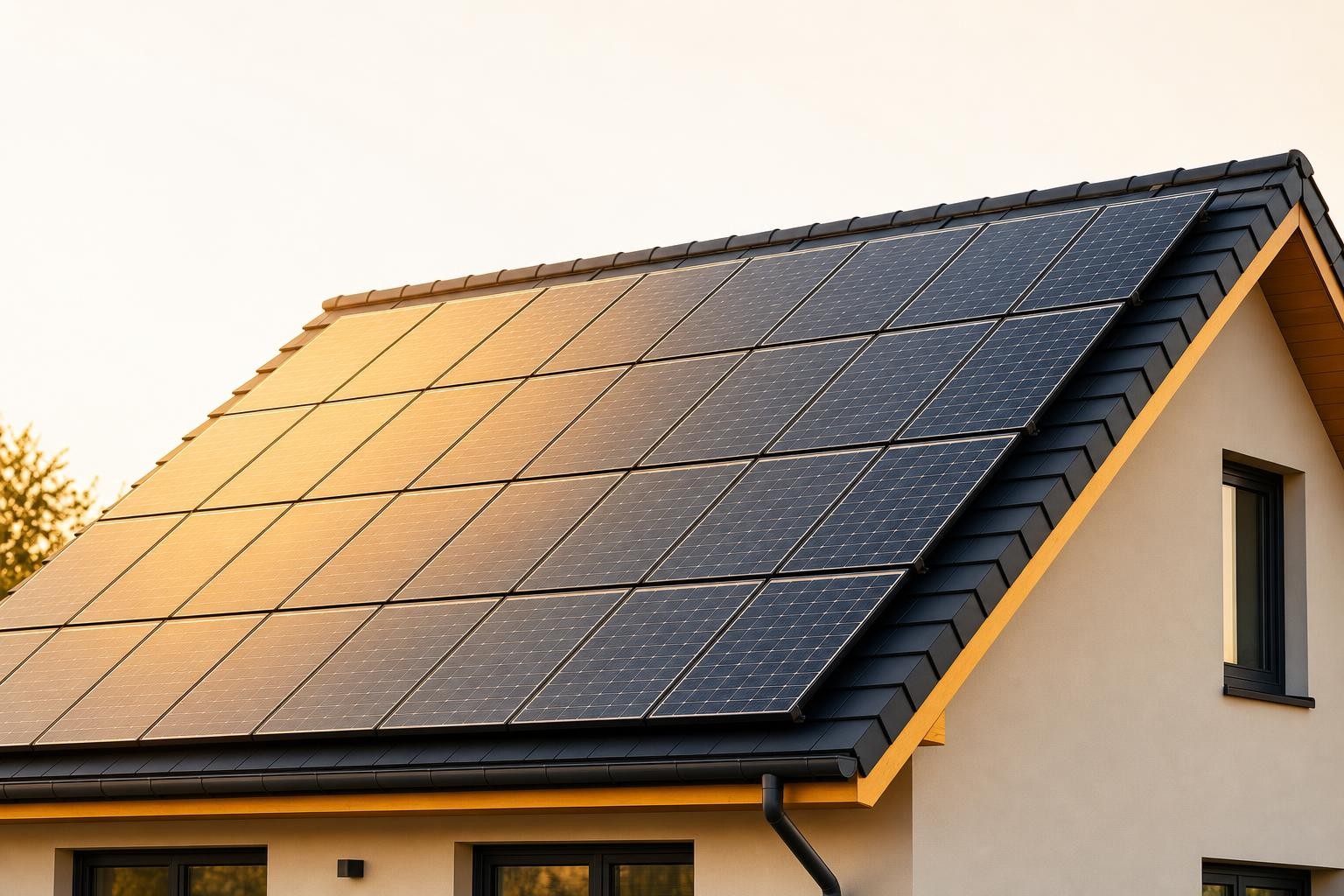
There's no single right answer - but there is a reliable method. The number of panels your home needs depends on three things: how much roof space you can actually use, how much electricity you want to generate, and how your roof faces the sun. Work through each angle and you'll arrive at a number that makes sense for your house, not a generic brochure estimate.
Method 1: Start With Your Roof
Before thinking about kilowatts, think about square metres.
The current sweet spot for residential rooftops is the 108-half-cut TOPCon format - roughly 1.7 m × 1.1 m, producing 400-440 W per panel. That works out to roughly 2 m² of roof area per panel, including a small gap around the frame.
But you can't cover every centimetre of your roof. Fire-safety setbacks, ridge lines, valleys, chimneys, skylights, and ventilation pipes all eat into the usable area. A realistic rule of thumb is that about 70% of a single roof plane is actually usable after those deductions. So a south-facing roof slope that measures 40 m² gives you roughly 28 m² to work with - enough for about 14 panels.
Measure your roof plane, not your floor plan. A pitched roof has more surface area than the footprint of your house. If you know the ridge-to-eave length and the width of one slope, multiply them together — that's your starting number.
Method 2: Work Backwards From Your Electricity Bill
The roof-area method tells you the maximum you can fit. The electricity-use method tells you how many panels you actually need.
Pull out your last 12 months of electricity bills and add up the total kWh. The average German household with an annual consumption of 3,500 kWh paid around €115 per month in 2025. In the UK, typical household consumption runs around 4,600 kWh per year. If you're in Italy, your usage is likely somewhere in between.
Once you have your annual kWh figure, you need to know how much a solar system produces per unit of installed capacity. This is measured in kWh per kWp per year - and it varies by location:
| Country / Region | Yield (kWh/kWp/year) | Notes |
|---|---|---|
| Germany (north) | 950–1,000 | Hamburg, Bremen, Schleswig-Holstein |
| Germany (south) | 1,050–1,150 | Bavaria, Baden-Württemberg |
| UK (average) | 850–950 | Varies widely north to south |
| Italy (north) | 1,100–1,200 | Lombardy, Veneto, Po Valley |
| Italy (south) | 1,300–1,500 | Sicily, Puglia, Calabria |
In Germany, a useful rule of thumb is that a PV system generates around 1,000 kWh of electricity per kWp per year - so a 6.9 kWp system can be expected to yield about 6,900 kWh. In Italy, the annual energy production from solar PV ranges from 1,000 to 1,500 kWh per installed kWp, depending on whether you're in Milan or Sicily.
The formula:
System size needed (kWp) = Annual consumption (kWh) ÷ Local yield (kWh/kWp)
Panels needed = System size (kWp) ÷ 0.44
A Worked Example
Let's put this together for a real-world scenario.
The house: A semi-detached home in Stuttgart, Germany. South-facing roof slope, 35 m² total area. Annual electricity consumption: 4,200 kWh.
Step 1 - Roof area check:
- Usable area: 35 m² × 70% = 24.5 m²
- Panels that fit: 24.5 ÷ 2 = 12 panels (5.3 kWp)
Step 2 - Consumption check:
- Stuttgart sits in southern Germany, so use 1,050 kWh/kWp as the yield estimate
- System needed: 4,200 ÷ 1,050 = 4.0 kWp
- Panels needed: 4.0 ÷ 0.44 = ~9 panels
Result: The roof can fit 12 panels, but 9 panels would already cover the household's full annual consumption. The homeowner could install 9-10 panels and cover their bill, or go to 12 panels to build in a buffer for future demand (an EV, a heat pump, or simply rising prices).
Method 3: Adjust for Orientation, Tilt, and Shading
The numbers above assume a south-facing roof at around 30-35°. Most roofs aren't perfect - and that's fine.
Orientation (azimuth): Even an orientation between south-west and south-east guarantees an interesting result, with losses not exceeding 10%. At southern European latitudes (37-42°N), east and west orientations reach 91-92% of south yield. At northern latitudes (50-60°N), the penalty is slightly larger at 87-88%. In neither case does orientation alone justify a flat refusal to install - a west-facing roof in Berlin still produces around 920 kWh/kWp annually, which is economically strong at current electricity prices.
Tilt angle: In Germany, the optimal tilt angle is usually between 30 and 40 degrees with south-facing orientation to maximize annual yield. But most pitched roofs fall somewhere in that range naturally. A tilt angle between 30 and 35 degrees is ideal; a deviation of up to 10 degrees only slightly reduces output.
Shading - the one that really hurts: For photovoltaic modules wired in strings, one shaded panel can reduce the efficiency of the entire string. Just 10% shading can cause up to 20% performance loss. A nearby tree, a chimney, or a dormer window can punch well above its visual weight. If shading is unavoidable, microinverters or power optimisers let each panel work independently and limit the damage.
Quick orientation adjustment guide:
| Roof faces | Yield vs. south-facing | Rough correction |
|---|---|---|
| South (ideal) | 100% | No adjustment needed |
| South-east / South-west | ~90-95% | Add ~1 extra panel |
| East or West | ~87-92% | Add 1-2 extra panels |
| North-east / North-west | ~60-70% | Significant loss - reconsider |
| North | Not recommended | - |
Putting It All Together
Three checks, one answer:
- Roof area sets your ceiling - the maximum panels you can physically fit.
- Electricity consumption sets your target - the minimum you need to cover your bill.
- Orientation, tilt, and shading adjust that target up or down.
If your target is lower than your ceiling, you have flexibility. If your ceiling is lower than your target, you'll need to either accept partial coverage or look at whether any shaded or north-facing areas can be excluded to free up better space.
These methods give you a solid ballpark — typically accurate to within 1–2 panels. For a precise number, you need your actual roof geometry, your exact location's irradiance data, and a shading analysis. That's exactly what a roof-tracing tool does automatically.
Trace Your Own Roof in Minutes
The fastest way to move from estimate to answer is to draw your roof on a map. The Solar Roof Planner at Energyhelper24 lets you enter your address, trace your roof planes on a satellite image, and instantly get a realistic panel count, system size, yearly output, and savings estimate - all for free, with no installer pressure.
Trace your roof on a satellite map and get a personalised panel count, system size, and yearly output estimate — free, no sign-up required.
Try the Free Solar Roof PlannerThe whole thing takes about five minutes. You'll come away knowing whether solar makes sense for your roof - and roughly how many panels it would take to get there.