Feed-In Tariffs and Export Payments Explained: Germany, the UK and Italy
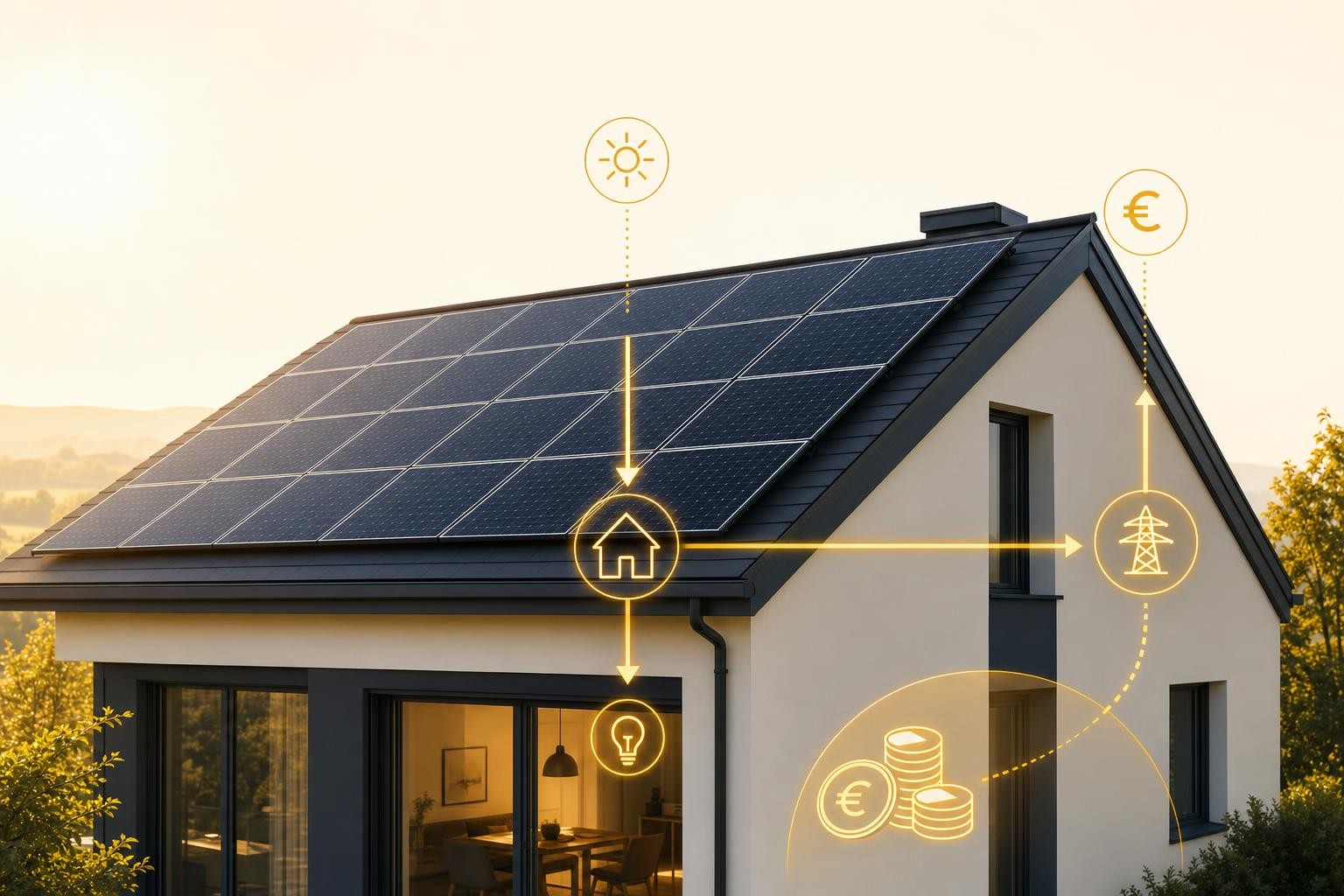
Picture this: it's a bright Tuesday morning, your solar panels are quietly humming away on the roof, and your house is running almost entirely on free sunshine. By mid-morning, you've covered the kettle, the washing machine, and the fridge - and your panels are still making more power than you need. That surplus flows out to the grid, and your energy company pays you for it.
That payment is what people call a feed-in tariff or an export payment. It's real money, and it's worth understanding - but it's also worth knowing why the kWh you use yourself is usually worth more than the one you export.
The Golden Rule: Self-Consumption First
Here's the simple maths that shapes everything else in this article.
When you use solar electricity yourself, you avoid buying it from the grid. In Germany, the UK and Italy, retail electricity costs roughly 25-35 cents (or pence) per kWh. When you export that same kWh, you typically receive somewhere between 5 and 15 cents/pence - a fraction of what you saved by using it yourself.
The true profitability of a modern solar system comes from maximising self-consumption. Every kilowatt hour you generate and consume yourself replaces expensive grid electricity and protects you from rising energy prices.
That doesn't mean export payments are worthless - they're a genuine bonus on top of your savings. But it does mean that timing your dishwasher, tumble dryer or EV charger to run during sunny hours is often the single most powerful thing you can do for your solar returns.
With that in mind, let's look at how each country handles the export side.
🇩🇪 Germany: The EEG Feed-In Tariff
Germany has one of the world's most established solar support systems, built on the Renewable Energy Sources Act (EEG). For homeowners, it works like this: your grid operator is legally required to buy your surplus solar electricity at a fixed rate, guaranteed for 20 years from the day your system is commissioned.
What rate will you get?
Anyone commissioning a system right now will receive a feed-in tariff of €0.0786/kWh (about 7.86 ct/kWh) for rooftop systems up to 10 kW that export surplus electricity to the grid, and €0.1247/kWh if the entire solar output is fed into the grid.
Most households choose the surplus (partial) feed-in model - you use what you can yourself and export only the rest. The full feed-in option (where everything goes to the grid) pays more per kWh, but you'd then have to buy all your electricity back at retail prices, which rarely makes sense for a family home.
The rate steps down - but your rate is locked
The EEG includes a scheduled reduction in rates for new installations. Since February 2024, these have fallen by 1% every six months - on 1 February and 1 August. Crucially, this reduction only affects new systems. Once your rate is secured, it remains stable for over 20 years.
So if you install today, you lock in today's rate for two decades. That's a genuinely reassuring level of planning security.
A change on the horizon - not yet law
There's one development worth knowing about, even though it's not finalised. A draft EEG 2027 bill would completely discontinue subsidies for new installations under 25 kW. The government's rationale is that falling costs have made many of these small-scale systems, particularly rooftop solar, economically viable through self-consumption alone.
The draft is dated 22 January 2026 and is still under inter-ministerial review. The EEG 2027 is expected to enter into force on 1 January 2027, though the timeline is ambitious given ongoing inter-ministerial coordination, outstanding parliamentary approval and required EU State aid clearance.
In plain English: if you're thinking about going solar in Germany, 2026 is a good year to act - you'd lock in the current guaranteed rate before any potential changes take effect. But keep an eye on the news, because the final law may differ from the leaked draft.
Germany quick summary
- Surplus feed-in rate (≤10 kW): ~7.86 ct/kWh from August 2025
- Full feed-in rate (≤10 kW): ~12.47 ct/kWh
- Rate locked for 20 years once your system is commissioned
- Rate steps down 1% every six months for new systems
- Draft EEG 2027 proposes ending the fixed tariff for systems under 25 kW from Jan 2027 — not yet law
🇬🇧 UK: The Smart Export Guarantee (SEG)
The UK took a different approach. The old Feed-in Tariff closed to new applicants in 2019. In its place came the Smart Export Guarantee, which launched in January 2020.
The Smart Export Guarantee replaced the old Feed-in Tariff and obliges every electricity supplier with more than 150,000 customers to publish at least one SEG export tariff. The key difference from Germany's system: there's no government-set rate. Suppliers compete, and you choose who to sell your surplus to.
How much can you earn?
As of July 2026, there are roughly thirty live SEG tariffs across the UK, ranging from a token 1p/kWh up to 32.17p/kWh paid by Octopus Intelligent Flux during peak export windows.
The average SEG payment is around 13p per kWh. But averages hide a lot. Good Energy's Solar Savings Exclusive tariff pays 25p per kWh of exported electricity, whereas Utility Warehouse pays 8p per kWh at most, and Utilita offers a 3p per kWh rate.
The spread is enormous - so shopping around genuinely matters.
You can mix and match suppliers
One of the SEG's most useful features: you can keep your existing electricity supplier and still switch your export contract - import and export are decoupled. So you could stay with your current supplier for the electricity you buy, while selling your surplus to whoever pays the most.
There's a catch: some of the highest-paying tariffs require you to be a customer of that supplier for your import too. The notable exception in 2026 is Good Energy, whose flat rate is open without switching your import supplier.
Rates move - keep an eye on them
SEG rates move - suppliers can change them with about 30 days' notice - so always confirm the live rate before you commit.
A recent example: British Gas is reducing its SEG export tariff from 15.1p to 8p for larger solar systems from July 2026. For most domestic systems (well under 15 kW), the higher rate continues - but it's a reminder that no SEG rate is permanent.
UK quick summary
- SEG replaced the old Feed-in Tariff for new systems from January 2020
- Rates set by suppliers, not the government — currently 1p to 32p/kWh
- Average rate: ~13p/kWh; best flat rate (no battery needed): Good Energy at 25p/kWh
- You can use a different supplier for export than for import
- Rates can change with ~30 days' notice — review yours annually
- You need an MCS-certified installation and a SMETS2 smart meter to qualify
🇮🇹 Italy: From Net Metering to Ritiro Dedicato
Italy's system has recently gone through its biggest change in years, so it's worth explaining both the old and new arrangements.
The old system: Scambio sul Posto (net metering)
For many years, Italian homeowners used Scambio sul Posto (literally "exchange in place") - a virtual net metering arrangement where the energy you fed into the grid was offset against the energy you drew from it, including a refund of network charges. It was particularly good for small domestic systems.
The last access to Scambio sul Posto was reserved for systems commissioned by 29 May 2025, with applications to the GSE submitted by 26 September 2025. New systems now use Ritiro Dedicato or Renewable Energy Communities (CERs).
The new system: Ritiro Dedicato
Ritiro Dedicato is the mechanism through which the GSE (Gestore dei Servizi Energetici - Italy's state energy services manager) purchases electricity produced by a solar system and fed into the grid, paying the producer a set amount for each kWh exported.
The key difference from the old system: Scambio sul Posto acted as a partial refund of your bill, while Ritiro Dedicato is a direct sale of energy. You sell your surplus to the GSE at a market-linked price, and they pay you monthly - though payments arrive two months in arrears, so energy exported in January is paid in March.
What does the GSE actually pay? For solar systems up to 1 MW, the Minimum Guaranteed Price set by ARERA for 2026 is €0.0475/kWh (4.75 ct/kWh). This applies when the wholesale market price is lower. If the market price is higher, the GSE automatically pays the better rate.
The honest reality: at midday, when your panels are producing most, the energy is worth very little - around 4-8 ct/kWh - because all Italian solar systems are generating at the same time and demand is low. In the evening, when demand peaks, the same energy can be worth 25-35 ct/kWh. This is the core argument for adding a battery in Italy: store the midday surplus and use (or sell) it when it's worth more.
Italy's tax deduction - still very much alive
There's a separate incentive that's genuinely valuable: the 50% Ecobonus (Personal Income Tax Credit) is one of Italy's most stable residential solar incentives, allowing homeowners to deduct 50% of installation costs over 10 years. Italy has officially extended this home renovation tax credit through 2026, confirmed in the government's budget law.
Italy quick summary
- Scambio sul Posto (net metering) is closed to new systems from May 2025
- New systems use Ritiro Dedicato: you sell surplus to the GSE at market-linked prices
- Minimum Guaranteed Price in 2026: ~€0.0475/kWh; market rates can be higher
- GSE pays monthly, roughly two months in arrears
- The 50% Ecobonus tax deduction on installation costs is valid through 31 December 2026
- A battery makes a big difference: it lets you use (or sell) energy when it's worth more
How the Three Countries Compare
| Feature | 🇩🇪 Germany | 🇬🇧 UK | 🇮🇹 Italy |
|---|---|---|---|
| Scheme name | EEG feed-in tariff | Smart Export Guarantee (SEG) | Ritiro Dedicato |
| Who sets the rate? | Government (fixed) | Suppliers (competitive) | Market / ARERA floor |
| Typical export rate | ~7.86 ct/kWh (≤10 kW surplus) | ~13p/kWh average; up to 25p+ | ~4.75–13 ct/kWh |
| Rate guaranteed for? | 20 years from commissioning | No guarantee — can change | Monthly, market-linked |
| Payment timing | Monthly via grid operator | Monthly via SEG supplier | Monthly, ~2 months in arrears |
| Key tax incentive | 0% VAT on hardware | 0% VAT on installation (to 2027) | 50% Ecobonus (to Dec 2026) |
| Big change coming? | Draft law may end FiT for <25 kW from Jan 2027 | Rates move freely; shop around | Net metering already ended for new systems |
The Practical Takeaway: Make the Most of What You Generate
Across all three countries, the message is the same: export payments are a welcome bonus, but self-consumption is where the real savings live.
Here's how to tilt the balance in your favour:
- Time your appliances. Run the dishwasher, washing machine and tumble dryer during the sunniest part of the day. Many modern appliances have a delay-start function - use it.
- Charge your EV from the sun. If you have an electric car, a smart charger can automatically draw from your panels during peak generation hours.
- Consider a battery. A home battery stores midday surplus for evening use. In Italy especially, this can dramatically improve what you earn from Ritiro Dedicato by shifting your export to higher-value hours.
- Pair solar with a heat pump. Running a heat pump on solar electricity is one of the most efficient uses of self-generated power - and in Italy, it can also unlock the higher 65% Ecobonus rate.
- Review your export tariff regularly (UK especially). SEG rates change. Switching takes about 30 minutes and costs nothing.
Rates and Rules Change - Stay Informed
One thing all three countries have in common: the rules are moving. Germany's EEG rate steps down every six months. UK SEG rates shift with supplier competition and wholesale prices. Italy has just completed a major transition away from net metering.
The numbers in this article are accurate as of mid-2026, but they will change. Always check the current rate with your grid operator (Germany), your chosen SEG supplier (UK), or the GSE portal (Italy) before making decisions.
What's Your Roof Actually Worth?
Before you can optimise your export income, you need to know how much your roof can generate - and how much of that you're likely to use yourself versus send to the grid.
That's exactly what our free Solar Roof Planner is built for. Trace your roof on a satellite map, and it estimates your system size, annual output, and - crucially - the split between self-consumption and export based on a typical household profile. No sign-up needed.
See how much of your solar output you'd use yourself vs. export — and what both are worth. Free, no sign-up, takes about two minutes.
Try the free Solar Roof PlannerDo I need to do anything to receive export payments?
In Germany, your installer registers your system with the grid operator and the Marktstammdatenregister — payments start automatically. In the UK, you need to sign up with an SEG supplier separately (it doesn't happen automatically), and you'll need a SMETS2 smart meter. In Italy, small rooftop systems are often registered via the simplified 'Modello Unico' process, which your installer handles.
Can I switch export tariff providers?
In the UK, yes — switching SEG provider is free, takes about 30 minutes, and doesn't affect your import contract. In Germany, the feed-in tariff is paid by your local grid operator, so there's nothing to switch. In Italy, you register with the GSE for Ritiro Dedicato; the contract renews annually and can be exited with 60 days' notice.
Does adding a battery reduce my export income?
A battery means you export less (because you store more for evening use), but you save more on import bills. In most cases the combined benefit is larger than export income alone — especially in Italy, where midday export rates are low and evening electricity is expensive. In the UK, a battery also unlocks higher time-of-use SEG tariffs that can pay significantly more per kWh.
Is export income taxable?
In the UK, SEG payments are tax-free for domestic households under the same exemption that applies to the old Feed-in Tariff. In Germany, small residential systems are generally exempt from income tax on feed-in income up to certain thresholds — check with a tax adviser for your specific situation. In Italy, Ritiro Dedicato income is taxable and must be declared on your annual tax return (Modello 730, Quadro D).
What happens to Germany's feed-in tariff after 20 years?
After the 20-year guaranteed period ends, you can continue feeding electricity into the grid at the current market value — typically 4–8 ct/kWh. Alternatively, you can maximise self-consumption, add a battery, or explore direct marketing options. The connection regulation allowing continued feed-in at market value has been extended until the end of 2032.